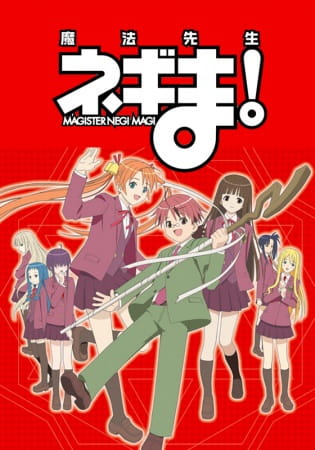
Negima! Magister Negi Magi
Is Negima! Magister Negi Magi worth watching?
Probably one to skip. Anime Codex rates Negima! Magister Negi Magi 4.63 out of 10 — scored on six criteria (story, characters, themes, world-building, animation, and cultural impact), not crowd votes. 226th of 226 on the Codex rubric — bottom 1% of the catalogue. The crowd rates it 2.32 higher than the rubric does — the Codex is harder on it than on 100% of the catalogue.
Where to watch
What the data says
Computed from the Codex rubric across the whole catalogue.
Summary
Negima! Magister Negi Magi (2005) adapts Ken Akamatsu's beloved Weekly Shonen Magazine manga into a 26-episode package that never finds the right footing. Its premise—a 10-year-old prodigy wizard teaching 31 teenage girls while hunting for clues about his father—blends harem comedy, magical-school action, and the inventive 'pactio' contract system that smartly fuses romance and combat mechanics. That central idea remains genuinely original within shonen, and Mahora Academy is a richly conceived setting. Unfortunately, the Xebec adaptation squanders these strengths. The cast is far too large for the runtime, leaving most students as single-trait sketches; only Asuna's grudging partnership with Negi receives meaningful development. Pacing is uneven, the Kyoto arc feels rushed, and anime-original material dilutes focus. Production values are notably weak, with off-model art and unconvincing action staging that fails to sell the magic battles. Compared to the best of its demographic, it falls short on narrative cohesion, emotional resonance, and visual craft, while leaning heavily on fanservice that undercuts its more interesting themes of responsibility and belonging. The franchise's true legacy lives in the manga and later reboots; this version is a flawed, forgettable entry redeemed only by the inherent charm of its source premise.
Criterion breakdown
Story & narrative
The 2005 Xebec adaptation tries to compress Ken Akamatsu's sprawling manga into 26 episodes and stumbles badly, particularly with the Kyoto field-trip arc feeling rushed and the anime-original detours diluting narrative momentum. The core premise—a 10-year-old wizard teaching 31 girls—generates episodic charm but little overarching tension, and the magic-tournament and evil-wizard threads never cohere into a satisfying through-line. Pacing lurches between slice-of-life class antics and underdeveloped action setpieces without earning either.
Character writing & growth
With 31 students plus Negi, the cast is impossibly large for 26 episodes, so most of Class 3-A (Konoka, Setsuna, the cheerleaders, the library trio) get a single defining trait and little else. Asuna's reluctant-partner dynamic with Negi and her grudge over Takahata is the only relationship given real arc, and even her growth feels truncated. Negi himself remains a static prodigy whose backstory about his father is gestured at but never emotionally explored in this adaptation.
Themes & emotional resonance
The show flirts with themes of responsibility, found-family, and a child shouldering adult expectations, but the harem-comedy framing and constant fanservice undercut any sustained emotional weight. Negi's quest to find his father could anchor a coming-of-age throughline, yet the anime barely develops it. Asuna's loneliness and abandonment issues hint at depth the series never commits to mining.
World-building & power system
Akamatsu's pactio system—where Negi forms magical contracts with partners who gain artifacts—is a genuinely clever twist that ties the harem premise to the power mechanics, though the 2005 anime underutilizes it compared to the later OVAs and manga. Mahora Academy as a vast self-contained school-city is an appealing setting with solid internal logic. The Western-wizardry-meets-Japanese-onmyodo blend (Setsuna's swordsmanship, Evangeline's vampirism) shows imagination, but the adaptation never explores its world's depth.
Animation & direction
Xebec's production is visibly budget-strapped, with inconsistent character art, stiff action choreography, and frequent off-model faces across the large cast. Direction by Nagisa Miyazaki struggles to stage the magic battles with any kinetic clarity, and the comedic timing often falls flat. The character designs lose much of Akamatsu's appeal in motion, and the show pales beside the more polished 2006 'Negima!?' reboot by Shaft.
Cultural impact
Negima was a major Weekly Shonen Magazine property and helped cement Akamatsu's transition from Love Hina into the magical-school harem-action template that influenced later works. The franchise spawned multiple anime, OVAs, and a live-action series, but this specific 2005 adaptation is widely regarded as the weakest entry and is not the version fans remember fondly. Its lasting footprint comes more from the manga than from this Xebec production.
Synopsis (from MAL)
10-year-old Negi Springfield is a wizard-in-training, and needs only to pass one more test in order to become a Master Wizard. Unfortunately, his final task is a bizarre one—to become a English teacher at an all-females boarding school. As soon as he arrives, he completely embarrasses one of his students, Asuna Kagurazaka, and replaces the teacher she loves, which garners her hatred. To make matters worse, Asuna learns that Negi is a wizard, and promises to tell unless he helps her out. But unfortunately, circumstances force them to work together to do many things, from fighting evil wizards to helping the class pass their final exam, with a lot of humor, magic, and romances thrown in. (Source: ANN, edited)
Ranked nearby



Explore rankings
Discussion
Set a display name above to post.
Loading discussion…