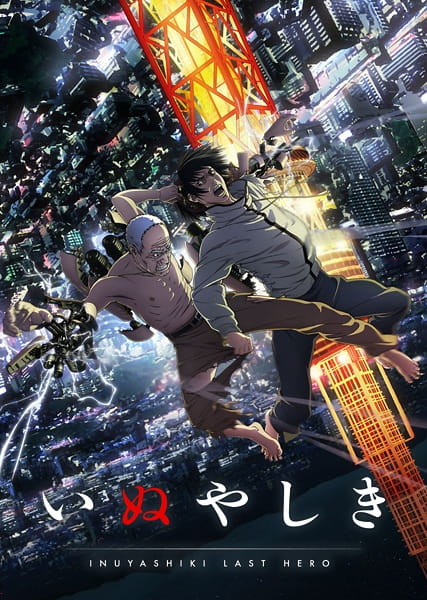
Inuyashiki
Is Inuyashiki worth watching?
Mixed — depends what you want. Anime Codex rates Inuyashiki 6.35 out of 10 — scored on six criteria (story, characters, themes, world-building, animation, and cultural impact), not crowd votes. 189th of 226 on the Codex rubric — bottom 17% of the catalogue. The crowd rates it 1.27 higher than the rubric does — the Codex is harder on it than on 85% of the catalogue.
Where to watch
Trailer
What the data says
Computed from the Codex rubric across the whole catalogue.
Summary
Inuyashiki stands out in seinen for its unusual hero—a 58-year-old, terminally ill, family-ignored salaryman reborn as a weaponized machine—and for pairing him against Hiro Shishigami, a teenage killer with identical powers but opposite morality. This contrast drives a sincere, often affecting meditation on humanity, compassion, and being unseen, with early episodes delivering real horror and emotional weight (Ichirou healing the dying, Hiro's casual home-invasion massacres). The show's strengths are its premise, its empathetic protagonist, and its willingness to be both brutal and tender. Its weaknesses are significant: the plot escalates into an over-the-top, credibility-straining climax; the pacing compresses the back half; Hiro's redemptive softening feels under-earned; and MAPPA's CGI-heavy animation is uneven, with stiff models and weightless spectacle undercutting key sequences. The supporting cast remains thin, serving theme more than character. Judged against the best of seinen, it is a good-but-flawed work—emotionally resonant and conceptually bold, particularly in centering an elderly protagonist rarely seen in anime, but hampered by execution problems in its second half and a refusal to ground its escalating stakes. Notable and worth watching for its premise and its tearful, humane core, if not definitive.
Criterion breakdown
Story & narrative
The dual-protagonist structure—Ichirou as the reluctant savior and Hiro Shishigami as the nihilistic killer—gives the narrative a clean thematic spine, and the early episodes (the nosebleed-killing-spree, the home invasion massacre that Hiro commits casually) land with genuine shock. However, the plot escalates into an absurd asteroid-deflection climax that strains credibility even by its own rules, and the pacing rushes the back half, compressing emotional beats that deserved more room. The premise is strong but the resolution leans on spectacle over the grounded human stakes that made the opening compelling.
Character writing & growth
Ichirou is a quietly affecting protagonist whose invisibility to his own family makes his turn toward heroism poignant, and the contrast with Hiro—a charismatic teenager who kills out of boredom and detachment—is the show's core engine. The weakness is that Hiro's eventual softening, triggered by his mother and his friend Naoyuki, feels under-earned given how monstrous he is established to be, and the supporting cast (Ichirou's family, the love interest Shion) remain thin functional pieces. Both leads are interesting concepts more than fully realized arcs.
Themes & emotional resonance
The meditation on what makes a human 'human'—when both leads are literally machines—is handled with more sincerity than subtlety, and Ichirou's compassion versus Hiro's empathy-deficit dramatizes it effectively. The depiction of an aging, disrespected salaryman finding purpose is genuinely moving and underexplored in the medium. It occasionally tips into melodrama and sermonizing, but the emotional resonance of Ichirou healing strangers while his own death looms is real.
World-building & power system
The premise—two ordinary people rebuilt as alien-tech weapons—is striking, but the show deliberately refuses to explain the mechanism, which works as restraint early on yet leaves the power system feeling arbitrary when abilities expand (hacking, flight, missile arms, planetary defense). Internal consistency frays as the scale balloons. The contemporary Tokyo setting is grounded and recognizable, but there's little world-building depth beyond the central conceit.
Animation & direction
MAPPA's CGI for the mechanical bodies and action is functional and occasionally striking in the combat and destruction sequences, but the blend of 3DCG character models against 2D backgrounds is inconsistent and sometimes distractingly stiff, particularly in facial work. Direction shines in the quieter horror beats—Hiro's massacres are staged with chilling calm—but the climactic set pieces look dated and weightless. A mixed technical showing.
Cultural impact
As a Hiroya Oku (Gantz) adaptation, it carried built-in attention and the manga has a solid following, with the anime reaching a wide audience and a strong MAL membership. It's frequently cited as a notable older-protagonist seinen and a darker MAPPA work, but it hasn't achieved the lasting fandom or discourse footprint of the studio's bigger titles, settling as a respected but not landmark entry.
Synopsis (from MAL)
Ichirou Inuyashiki is a 58-year-old family man who is going through a difficult time in his life. Though his frequent back problems are painful, nothing hurts quite as much as the indifference and distaste that his wife and children have for him. Despite this, Ichirou still manages to find solace in Hanako, an abandoned Shiba Inu that he adopts into his home. However, his life takes a turn for the worse when a follow-up physical examination reveals that Ichirou has stomach cancer and only three months to live; though he tries to be strong, his family's disinterest causes an emotional breakdown. Running off into a nearby field, Ichirou embraces his dog and weeps—until he notices a strange figure standing before him. Suddenly, a bright light appears and Ichirou is enveloped by smoke and dust. When he comes to, he discovers something is amiss—he has been reborn as a mechanized weapon wearing the skin of his former self. Though initially shocked, the compassionate Ichirou immediately uses his newfound powers to save a life, an act of kindness that fills him with happiness and newfound hope. However, the origins of these strange powers remain unclear. Who was the mysterious figure at the site of the explosion, and are they as kind as Ichirou when it comes to using this dangerous gift? [Written by MAL Rewrite]
Ranked nearby


Explore rankings
Discussion
Set a display name above to post.
Loading discussion…