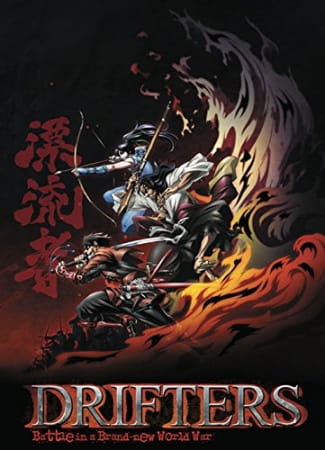
Drifters
Is Drifters worth watching?
Worth a look. Anime Codex rates Drifters 6.63 out of 10 — scored on six criteria (story, characters, themes, world-building, animation, and cultural impact), not crowd votes. 166th of 226 on the Codex rubric — bottom 28% of the catalogue. The crowd rates it 1.25 higher than the rubric does — the Codex is harder on it than on 84% of the catalogue.
Where to watch
Trailer
What the data says
Computed from the Codex rubric across the whole catalogue.
Summary
Drifters is Kouta Hirano channeling his Hellsing energy into a historical-fantasy war saga, and within seinen action it stands out for sheer concept: legendary warriors from across human history are conscripted into a proxy war over a fantasy continent's fate. The pairing of bloodthirsty samurai Toyohisa with the scheming, gleeful Nobunaga generates excellent dynamics, and the reframing of the antagonist Ends as humans broken by their own worlds lends the conflict unexpected moral texture. The world-building — period-accurate tactics as combat, a deliciously odd roster of historical cameos — is its strongest asset, and the production delivers brutal, well-timed action punctuated by Hirano's trademark comedic deflation. Its weaknesses are real, though. At 12 episodes it is structurally incomplete, stopping mid-war as a prologue rather than a resolved story, and its thematic ambitions around persecution and vengeance stay buried under bombast. Most characters are static historical archetypes rather than figures who grow. The result is a stylish, entertaining, and genuinely original entry that never quite cashes in its narrative or emotional promise — held back further by the source manga's glacial pace, which left the anime stranded without a second season. A strong cult work, not a definitive one.
Criterion breakdown
Story & narrative
The premise of historical warriors yanked from their deathbeds into a fantasy proxy war is genuinely compelling, and Kouta Hirano's setup of Drifters versus Ends as opposing forces in a demihuman genocide gives the conflict real stakes. However, the 12-episode run is structurally incomplete — it ends mid-arc after the Battle of Carneades fortress without resolving the larger war, functioning more as an extended prologue than a complete narrative. The pacing also lurches between explosive set-pieces and dense political exposition delivered through Olminu and the Octobrist organization.
Character writing & growth
Toyohisa is a refreshingly uncomplicated battle-junkie whose feudal samurai ethics create friction and comedy against modern sensibilities, and Nobunaga steals the show as a gleeful strategist who treats nation-building like a game, repurposing matchlock tactics and propaganda. The Ends — particularly the embittered Black King and a weeping Joan of Arc reborn as a vengeful pyromaniac — are more thematically interesting than fully developed. Genuine arcs are scarce, though; most cast members are static archetypes defined by historical persona rather than growth across the short run.
Themes & emotional resonance
The show gestures at meaty ideas — the Ends are humans broken by the cruelty of their original worlds, recasting the antagonists as victims radicalized into nihilistic vengeance, which complicates the hero/villain binary. The demihuman persecution and Joan's trauma give weight to questions of who deserves salvation. But these threads stay underdeveloped, frequently buried under bombast and gallows humor, so the emotional resonance lands as intermittent rather than sustained.
World-building & power system
The conceit of a fantasy world stocked with displaced figures from across human history — Hannibal, Scipio, Anastasia, Gilles de Rais, Rasputin — is inventive and lets Hirano stage absurd historical crossovers with internal logic. The Orte Empire's anti-demihuman politics and the Octobrist magic-users add scaffolding, and the period-accurate weaponry (Shimazu tactics, Yoichi's archery) is a clever 'power system.' The white-hallway summoning mechanism and Murasaki's bureaucracy remain tantalizingly unexplained, which is both intriguing and frustrating.
Animation & direction
Hoods Entertainment renders Hirano's distinctive heavy-lidded, sharp-jawed character designs faithfully, and the action — Toyohisa's brutal charges, Yoichi's arrow volleys — has visceral impact with strong gore choreography. The signature stylistic flourish is the abrupt tonal shifts into flat, exaggerated comedy faces, which the direction handles with good timing. CG and crowd scenes occasionally look stiff, and the overall production is solid rather than spectacular.
Cultural impact
As Kouta Hirano's follow-up to Hellsing, Drifters arrived with a built-in fanbase and the same blood-soaked, swaggering sensibility, earning a strong 7.88 MAL score and broad recognition. Its historical-figure crossover premise has been frequently cited and memed, but its impact is constrained by the manga's notoriously slow release and the anime's failure to continue beyond one season, leaving it a cult favorite rather than a genre-defining work.
Synopsis (from MAL)
At the Battle of Sekigahara in 1600, Toyohisa Shimazu is the rearguard for his retreating troops, and is critically wounded when he suddenly finds himself in a modern, gleaming white hallway. Faced with only a stoic man named Murasaki and hundreds of doors on both sides, Toyohisa is pulled into the nearest door and into a world completely unlike his own. The strange land is populated by all manner of fantastical creatures, as well as warriors from different eras of Toyohisa's world who were thought to be dead. Quickly befriending the infamous warlord Nobunaga Oda and the ancient archer Yoichi Suketaka Nasu, Toyohisa learns of the political unrest tearing through the continent. Furthermore, they have been summoned as "Drifters" to fight against the "Ends," people who are responsible for the creation of the Orte Empire and are trying to annihilate the Drifters. As the Ends grow more powerful, so does the Empire's persecution of elves and other demihumans. It is up to Toyohisa and his group of unconventional heroes to battle in a brand-new world war to help the Empire's subjects, while challenging the Ends protecting the land to claim it for themselves. [Written by MAL Rewrite]
Ranked nearby

Explore rankings
Discussion
Set a display name above to post.
Loading discussion…