Fushigi Yûgi
Is Fushigi Yûgi worth watching?
Worth a look. Anime Codex rates Fushigi Yûgi 6.83 out of 10 — scored on six criteria (story, characters, themes, world-building, animation, and cultural impact), not crowd votes. 151st of 226 on the Codex rubric — bottom 34% of the catalogue. The crowd rates it 0.77 higher than the rubric does — the Codex is harder on it than on 63% of the catalogue.
Where to watch
What the data says
Computed from the Codex rubric across the whole catalogue.
Summary
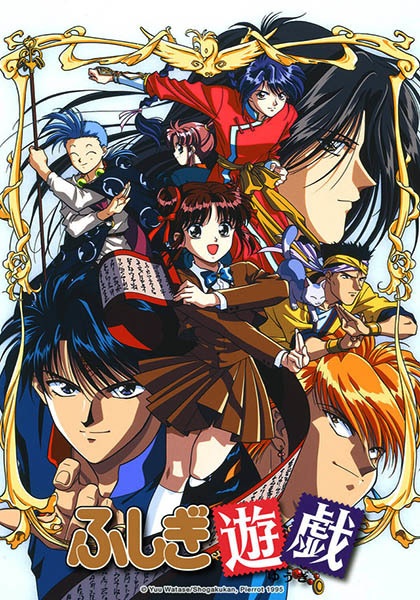
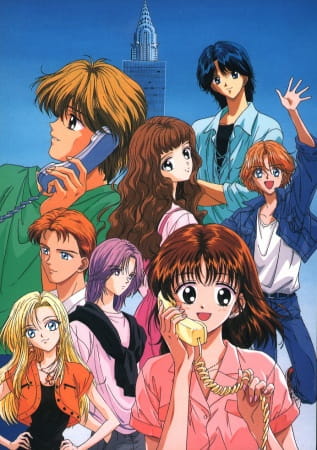
Fushigi Yûgi is a cornerstone 90s shoujo that helped codify the reverse-harem isekai template, sending an ordinary schoolgirl into a Chinese-mythology-inspired world to summon a god and gather seven bishonen warriors. Its greatest strength is the Miaka–Yui rivalry: a friendship soured by trauma and manipulation that gives the second half genuine tragic momentum and elevates the show above simple wish-fulfillment. The series handles surprisingly mature themes — assault, betrayal, the price of desire — with more honesty than its melodramatic surface suggests. Weaknesses are real, however. The pacing droops in its middle episodes, the plot manufactures conflict through repeated misunderstandings and forced separations, and Miaka is an uneven protagonist whose passivity and hunger-driven comedy undercut her arc. The Suzaku/Seiryuu cosmology is evocative but applied loosely, and the setting stays decorative rather than fully realized. Pierrot's animation is dated even for its time, with off-model frames and static dramatic beats, though the designs and music endure. Judged against the best shoujo of its era, it is a flawed but historically significant work — emotionally affecting when it commits to its central female friendship, less so when it retreats into romantic melodrama. A good, influential, imperfect classic.
Criterion breakdown
Story & narrative
The 'trapped in a book' isekai framing was inventive for 1995, and the dual-priestess structure pitting Miaka (Suzaku) against the manipulated Yui (Seiryuu) gives the back half real dramatic stakes. However, the pacing sags badly in the middle stretch, leaning on repetitive 'gather the next warrior' beats and contrived separations between Miaka and Tamahome, and the show frequently manufactures melodrama through misunderstandings that could be resolved by a single conversation.
Character writing & growth
Yui's slow corruption from betrayed best friend into vengeful Seiryuu priestess is the strongest arc, grounded in a genuinely traumatic inciting event and survivor's resentment. Nuriko's evolution and Hotohori's quiet dignity add texture, but Miaka herself is an inconsistent lead — alternately brave and frustratingly passive, often defined by hunger gags and her devotion to Tamahome rather than agency, and several Celestial Warriors remain thin archetypes.
Themes & emotional resonance
The show probes friendship-turned-rivalry, the cost of wishes, and bodily autonomy with surprising frankness for its era, including assault threats that carry real weight rather than titillation. Yui and Miaka's fractured bond resonates more than the central romance, though the relentless 'love conquers all' messaging sometimes flattens the more interesting moral ambiguity it raises.
World-building & power system
The Suzaku/Seiryuu cosmology drawn from the Four Symbols of Chinese astronomy gives the Universe of the Four Gods a coherent mythological backbone, and the Celestial Warrior system with hidden symbols is serviceable. Yet the pseudo-ancient-China setting stays largely cosmetic, internal rules around the book, wishes, and warrior powers are applied loosely, and Konan and Kutou feel underdeveloped as nations.
Animation & direction
Standard mid-90s Pierrot TV production with frequent off-model shots, recycled animation, and a reliance on still frames during dramatic peaks. Character designs after Yuu Watase are appealing and the score is memorable, but direction rarely elevates key emotional scenes beyond competent, and action sequences in particular look stiff.
Cultural impact
A foundational reverse-harem and shoujo-isekai title that heavily influenced the 'girl pulled into another world surrounded by beautiful men' template seen in later works. It enjoyed strong international fan devotion in the early fansub era and remains a frequently cited classic of 90s shoujo.
Synopsis (from MAL)
During a visit to the National Library, Miaka Yuuki and Yui Hongo stumble upon a strange old book that casts a red light, sucking them inside its unfamiliar world. Upon arrival, the two encounter hostile slave traders and barely escape with the help of Tamahome—a powerful young man bearing a Chinese symbol on his forehead. But, a moment later, the red light returns and takes Yui away. Desperate to reunite with her companion, Miaka asks Tamahome for assistance. However, the situation escalates when the pair encounters the land's emperor, Hotohori, who believes Miaka is the foretold priestess of the kingdom's protector god Suzaku. By gathering the god's seven Celestial Warriors, the priestess can summon Suzaku and have all her wishes granted. Hotohori hopes this will save his country, and since it appears to be a fitting solution to the girl's problems as well, he convinces her to accept the role. Meanwhile, at the library, Yui realizes she has been brought back alone. Unable to intervene, she helplessly witnesses Miaka traversing through courageous trials as the mysterious book's heroine. [Written by MAL Rewrite]
Ranked nearby

Explore rankings
Discussion
Set a display name above to post.
Loading discussion…