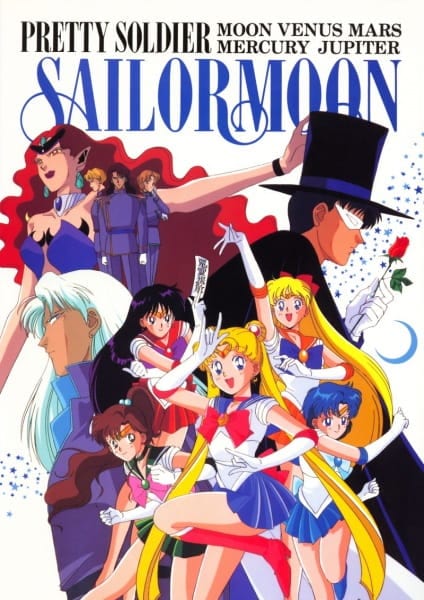
Sailor Moon
Is Sailor Moon worth watching?
Worth a look. Anime Codex rates Sailor Moon 7.15 out of 10 — scored on six criteria (story, characters, themes, world-building, animation, and cultural impact), not crowd votes. 119th of 226 on the Codex rubric — bottom 48% of the catalogue. The crowd rates it 0.60 higher than the rubric does — the Codex is harder on it than on 54% of the catalogue.
Where to watch
Streaming availability varies by region — check your local services.
Trailer
What the data says
Computed from the Codex rubric across the whole catalogue.
Summary
Sailor Moon's first series is a foundational shoujo work whose influence vastly exceeds its technical execution. Its great strength is Usagi herself — a crybaby klutz rather than a polished heroine — whose reluctant journey toward courage and her destined identity as Princess Serenity gives the season genuine emotional arc. The astrological guardian mythology, ritualized transformations, and the Moon Kingdom backstory established a template that defined an entire genre. The supporting senshi are distinctly characterized, and the Beryl finale delivers real pathos around love, sacrifice, and reincarnation. Its weaknesses are equally clear: long stretches of repetitive monster-of-the-week filler before the plot accelerates, a thin Dark Kingdom antagonist roster, and tonal whiplash between comedy and tragedy. The 1992 animation is inconsistent, relying heavily on recycled stock footage and showing visible budget strain outside its iconic set-piece sequences. Judged against the best of shoujo and magical-girl anime, it is not the most refined execution of its own ideas — later entries and successors polished what it pioneered. But as the work that crystallized the team magical-girl formula and carried shoujo to a global audience, its importance and charm remain undeniable. Good, influential, and flawed in equal, honest measure.
Criterion breakdown
Story & narrative
The first season builds a satisfying arc from monster-of-the-week energy thefts toward the Silver Millennium reveal and the tragic backstory linking Usagi to Princess Serenity and Mamoru to Prince Endymion. However, the early-to-mid stretch leans heavily on repetitive Dark Kingdom episodic filler, and the season's pacing sags before the Beryl confrontation finally raises the stakes. The climactic memory-and-rebirth payoff is genuinely strong for shoujo of its era, but it takes too long to arrive.
Character writing & growth
Usagi is a refreshingly flawed shoujo lead — lazy, cowardly, and tearful — whose gradual acceptance of responsibility gives the season real growth rather than instant heroism. The supporting Guardians are distinctly drawn (Rei's prickliness, Ami's bookishness, Makoto's tenderness behind toughness), though Mamoru and several inner senshi remain underdeveloped until later. The Usagi–Mamoru antagonistic-to-fated romance is charming but relies more on destiny than earned chemistry in this first series.
Themes & emotional resonance
Friendship, sacrifice, and the idea that an ordinary, imperfect girl can be heroic resonate powerfully and define a generation of magical-girl storytelling. The finale's themes of love transcending death and the burden of past lives land with surprising emotional weight for a Nakayoshi title. It occasionally undercuts itself with comedic tonal whiplash that dilutes the gravity.
World-building & power system
The astrology-and-planetary-guardian conceit, the Moon Kingdom mythology, and transformation/attack rituals tied to celestial bodies form an original and internally coherent fantasy framework that became genre-defining. The Dark Kingdom is comparatively thin as an antagonist faction, with Beryl's generals feeling more like episode-engines than a developed power. The premise's originality outweighs the shallowness of the villain side.
Animation & direction
Ikuhara and Sato's direction injects flair, and the transformation and attack sequences are iconic and reused with deliberate ritual rhythm. But the 1992 TV production shows clear budget limitations — inconsistent character drawings, recycled animation cuts, and flat backgrounds in routine episodes. The stock footage that defines the franchise also exposes how much animation labor it was designed to save.
Cultural impact
Sailor Moon essentially codified the team-based magical-girl genre and inspired countless successors from Pretty Cure to Madoka. Its global broadcast made it a gateway anime for Western audiences and a landmark for shoujo's international reach, alongside notable queer-coded representation in later seasons. Its cultural footprint is among the largest of any shoujo work ever produced.
Synopsis (from MAL)
Usagi Tsukino is an average student and crybaby klutz who constantly scores low on her tests. Unexpectedly, her humdrum life is turned upside down when she saves a cat with a crescent moon on its head from danger. The cat, named Luna, later reveals that their meeting was not an accident: Usagi is destined to become Sailor Moon, a planetary guardian with the power to protect the Earth. Given a special brooch that allows her to transform, she must use her new powers to save the city from evil energy-stealing monsters sent by the malevolent Queen Beryl of the Dark Kingdom. But getting accustomed to her powers and fighting villains are not the only things she has to worry about. She must find the lost princess of the Moon Kingdom, the other Sailor Guardians, and the Legendary Silver Crystal in order to save the planet from destruction. [Written by MAL Rewrite]
Ranked nearby


Explore rankings
Discussion
Set a display name above to post.
Loading discussion…