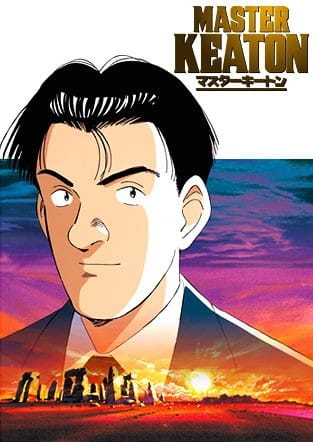
Is Master Keaton Worth Watching? A 7.77 That Beats the Crowd by Betting Everything on World and Character
Madhouse's 1998 Urasawa adaptation earns 24 episodes of your time on the strength of two criteria — its lived-in European world and a fixed-lens protagonist — provided you accept an episodic structure that never accumulates.
Madhouse's 1998 Urasawa adaptation earns 24 episodes of your time on the strength of two criteria — its lived-in European world and a fixed-lens protagonist — provided you accept an episodic structure that never accumulates.
Most people just want to know: is Master Keaton worth your time, and for whom? Answer that fast, then back it with the rubric. Yes — if you want procedural seinen with real research behind it and a protagonist whose competence never mutates into spectacle. No — if you need a season-long arc, a lead who visibly changes, or animation that justifies Madhouse's name on the credits.
What the Consensus Gets Wrong About Master Keaton
The MyAnimeList crowd scores it 7.65. That number reads like faint praise for a show whose actual problems and actual virtues are both sharper than a mid-7 suggests. The Codex lands at 7.77 — twelve hundredths higher, which is not a rounding error but a genuine disagreement about which criteria decide the show. The consensus treats Master Keaton as a slightly-above-average curiosity, a footnote to Monster and 20th Century Boys that only completionists chase. That framing is wrong in both directions: it undersells what the show actually does at a technical level in world-building and character construction, and it oversells the ceiling by implying the show is simply a lesser Urasawa when its structural intent is entirely different.
The show aired on Nippon Television across 1998–99, 24 episodes, adapted from the Hokusei Katsushika and Naoki Urasawa manga that ran in Big Comic Original from 1988. This is early Urasawa — the humanist procedural mode before he learned to sustain a thousand-page mystery. Reading it as failed Monster is a category error. It's a different form doing different work, and the rubric grades it on that form.
The World Score Is Doing the Heavy Lifting
The single highest number on the card is world-building at 8.2, and it is not decorative. What separates Master Keaton from every other travel-mystery anime of its era is that the research is real. Insurance-investigation procedure at Lloyd's, survival tactics that read as SAS-derived rather than screenwriter-derived, archaeological methodology that behaves like methodology — these are not window dressing. Katsushika and Urasawa built the source with evident specificity, and Madhouse's adaptation preserves it. The pan-European settings — rural France, Germany, the Mediterranean coast — are drawn with location logic rather than establishing-shot laziness. A wine-country episode looks like wine country; a Rhine village doesn't collapse into the same visual grammar as a Marseille alley.
The reason this matters for a decision-first verdict is that grounded seinen procedurals age well precisely because they didn't chase a house style. The show still watches cleanly in a way that mid-tier late-'90s fantasy or action work does not. If you responded to the way Heavenly Delusion treated its world as a load-bearing element rather than a backdrop, Master Keaton is operating in the same register — minus the mystery-box structure, plus twenty-four self-contained problems.
Character at 8.0, But Read the Fine Print
Taichi Hiraga-Keaton earns the character score without doing what most protagonists do to earn one. He does not change. Across 24 episodes he is essentially the same man in episode one and episode twenty-four — half-British, half-Japanese, Oxford-trained archaeologist, Falklands SAS veteran, Lloyd's investigator, quietly paternal toward his daughter Yuriko, warmly exasperated by his romantic-novelist father Taihei. The rubric credits this at 8.0 because the writing understands what it's doing: Keaton is a fixed moral lens, and the growth in each episode belongs to whoever crosses his path.
That is a legitimate seinen mode and it works — but it caps the ceiling. Viewers who need a conventional arc, the kind that carries Cross Game to a 9.0 on the same criterion, will feel Master Keaton as static. It is static, deliberately. The competence is revealed by inference across cases rather than delivered as backstory blocks, which is why the SAS material never tips into wish-fulfillment: he does not brawl his way out, he thinks his way out, and when he uses the training it's presented as workmanship rather than spectacle.
Where the Rubric Docks It: Animation and Cultural Reach
The animation score is 7.0 and the cultural score is 6.5, and those two numbers are the honest reason Master Keaton isn't in the top tier. Madhouse's late-'90s TV production is functional. Character acting is strong, framing is composed and dialogue-serving, but the show cannot hide its TV budget — flat sequences in talky episodes, limited motion where a bigger production would fill the frame. Satoshi Kon turns up on key animation for episode 15, which is a data point worth noting and roughly the level of prestige labor the show could afford. Compare this to what Madhouse threw at their higher-priority projects in the same window and the seams show.
Cultural impact at 6.5 reflects reality rather than punishment. Licensing complications kept the show off Western shelves for years — Pioneer's English release didn't arrive until 2003–2004 — and its footprint remains a cult one, a connoisseur's recommendation rather than a genre landmark. It foreshadows Urasawa's later work without ever having entered the general conversation the way Monster did.
The Steelman: Isn't Episodic Just a Nice Way to Say Forgettable?
The strongest case against watching Master Keaton is structural. Twenty-four self-contained mysteries with a static protagonist build no cumulative tension. A viewer who finishes episode twelve and takes a two-week break has lost nothing, because there is nothing to lose track of. A few episodes lean too heavily on archaeology-lecture mode and feel slighter than the human-drama installments. The themes score of 7.9 acknowledges that the show occasionally moralizes too neatly — a case about a displaced refugee or an aging veteran resolves with a tidiness the premise didn't quite earn.
That critique is fair. The rubric answers it by pointing at what the format is actually for: this is slice-of-adventure seinen, and the best individual episodes — the wine-country reconciliation between estranged generations, the survival-in-the-wilderness cases — are as tight and humane as short-form drama gets in the medium. The lack of an arc is a genre feature, not a bug, and it's the same reason Nodame Cantabile survives its structural quirks: the form is doing what the form is for.
The Verdict
Watch it if you want procedural seinen where the research is real, the protagonist is a lens rather than an arc, and the individual episodes carry the weight. Skip it if you need an overarching mystery, visible growth in the lead, or animation that competes with Madhouse's flagship work. The 7.77 is honest — a show carried by world at 8.2 and character at 8.0, taxed by a 7.0 on animation and a 6.5 on cultural reach that reflects a cult footprint the show has never outgrown.
Featured in the Codex




More from The Codex
The Seven Deadly Sins Is a 6.60 Wearing a 7.60 Costume: A One-Point Gap Earned by Groping Gags and Convenient Flashbacks
The Seven Deadly Sins scores 6.60 on the Codex against MyAnimeList's 7.60 because the crowd is grading a Netflix breakout and a Ban-and-King friendship, not the 24 episodes A-1 Pictures actually broadcast in 2014.
The 10.0 That Built a Sunday: How Sazae-san's Cultural Score Carries a 6.58 Scorecard
Sazae-san is a case study in how a single criterion — cultural — can define how a show is remembered, and the 10.0 the Codex hands Eiken's 1969 institution is doing every bit of the heavy lifting its other five scores refuse to.
The Sebastian Problem: Why Black Butler Sits 1.10 Below Its MAL Line and the Crowd Refuses to Notice
Black Butler (Kuroshitsuji) posts a 1.10-point gap between MyAnimeList's 7.65 and the Codex 6.55 because the crowd is grading Sebastian's silhouette and a Phantomhive aesthetic, not the anime-original finale A-1 Pictures actually shipped in 2009.
Discussion
Set a display name above to post.
Loading discussion…