Bocchi the Rock! Review: An 8.36 That Lives on Animation and Character, Pays for It on Story
Judged against one consistent rubric, CloverWorks' 2022 breakout is best understood by which criteria carry it and which drag it down — not by a single number.
Judged against one consistent rubric, CloverWorks' 2022 breakout is best understood by which criteria carry it and which drag it down — not by a single number.
Bocchi the Rock! is a show whose reputation runs about a third of a point ahead of its scorecard, and the gap is not an accident. The Codex lands it at 8.36. The story criterion is doing the losing; the animation criterion is doing the lifting; and the middle four criteria are quietly arguing about whether a band-formation slice-of-life earns the cultural footprint it now indisputably has.
The Bocchi the Rock! Review Against the Consensus Number
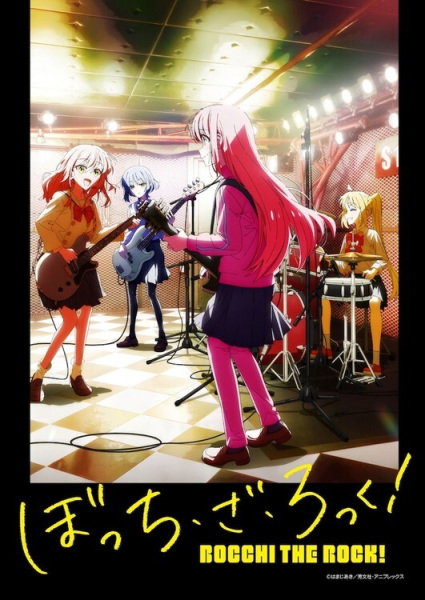
MyAnimeList scores CloverWorks' twelve-episode 2022 adaptation at 8.73. The Codex weighted score is 8.36 — a 0.37-point gap that the site's rubric attributes almost entirely to what a music-CGDCT plot refuses to do. The crowd is grading a phenomenon: Kessoku Band charting, Shimokitazawa tourism, guitar sales up, the word "bocchi" turning into a fandom shorthand for social anxiety. Those things are real, and the cultural criterion registers them at 8.5. But an 8.73 aggregate treats every episode as if it were doing the work of the finale, and it isn't. Six of these episodes are structurally identical to any other Manga Time Kirara adaptation of the last decade. What makes Bocchi the Rock! specifically Bocchi the Rock! is compressed into a handful of directorial decisions and one exceptionally well-drawn protagonist.
This is the popularity-versus-quality problem in miniature: an r = 0.33 correlation across the catalogue means the crowd's number and the rubric's number will agree on the shelf but disagree on the ranking, and Bocchi is a textbook case of the latter.
Where the Story Actually Loses Points
The narrative scores 7.5, and that is where most of the gap with MyAnimeList lives. The plot is a conventional band-formation arc: Hitori Gotou joins Kessoku Band, plays her first live shows, works through the summer festival, and lands the culminating Starry performances. Structurally this is indistinguishable from a dozen other cute-girls-with-instruments premises. What lifts it above the floor is the episodic discipline — the show cares about incremental milestones (busking to fund gear, the school festival closer) rather than manufactured crises — but discipline is not the same as invention. There is no antagonist. There is no external stake. The only conflict on the board is Bocchi's internal anxiety, and while that anxiety is rendered with real specificity, it cannot alone carry twelve episodes of dramatic weight. The show coasts on charm. The rubric notices.
Compare this to how the Codex reads other character-driven pieces where the story criterion also sags — Kimi ni Todoke at 7.78, for instance, where a romance that refuses to progress is the load-bearing weakness. Bocchi has the same problem in a different key: the plot's job is to move Bocchi somewhere, and by episode twelve she has moved a credible, small distance. Credible and small is a virtue for character work and a ceiling for story.
Where the Character Writing Earns 9.0
Hitori Gotou is one of the most precisely observed social-anxiety portraits the demographic has produced. The spiraling internal monologues, the dissociation gags where she physically melts or crumbles or files herself away in a cardboard box, the panicked recalibrations mid-conversation — these are not decorative tics. They map onto specific, believable behavioral patterns, and the show refuses to cure her. The bottleneck slide improvisation when her string breaks mid-performance, the solo busking to earn gear money — these are competence moments that do not resolve the anxiety, they route around it. That distinction is what separates a character study from a wish-fulfillment arc.
The supporting trio holds up under scrutiny. Nijika Ijichi's earnest bandleader energy, Ryou Yamada's deadpan freeloading, Ikuyo Kita's extroverted-but-fragile pivot — each has enough interiority to function as more than a color-coded archetype. Kita's admiration for Ryou is the strongest relational thread outside Bocchi's own head. The honest weakness is that Ryou and Nijika get less internal real estate than the two poles of the anxiety-versus-extroversion axis, and the rubric registers that. Nine is not ten.
The Animation Score Is Doing the Heaviest Lifting
At 9.3, animation is the highest criterion on the sheet, and it deserves it. CloverWorks' direction — the visual language, not just the sakuga — is the reason this show is a phenomenon rather than a well-regarded footnote. Bocchi's anxiety is externalized through wildly shifting media: claymation cutaways, pencil-sketch degradation, live-action photo collage, textures that melt and reconstitute inside a single cut. These are not stylistic flourishes bolted onto ordinary scenes. They are the show's grammar. Toshiyuki Satou's key animation on episodes 1 and 4 establishes the elastic register early; the performance sequences use rotoscoped guitar work that reads as physically credible in a genre that usually cheats instrument playing.
Without this direction, Bocchi is a 7.something show. With it, the visual identity becomes indivisible from the character writing — the anxiety and the animation are the same argument. That is rare, and the score reflects it.
Themes and World: The Quiet 8s
Themes lands at 8.5. The show takes social anxiety seriously as both aspiration and pain, and it frames music as a bridge for those who cannot use words — a thesis it actually earns in the busking arc and the broken-string moment rather than merely gesturing at. The occasional puncturing of emotional beats by rapid-fire gags costs it half a point; the resonance is authentic, but the tonal discipline isn't always.
World scores 8.0 on the specificity of the Shimokitazawa live-house scene. Starry as a venue, the economics of ticket quotas, the used-gear culture, the grounded portrayal of amateur skill progression — these details are rendered with a fidelity most slice-of-life shows do not bother with. The niche is small. Within it, the show is credible and lived-in.
The Steelman: Cultural Impact as a Tiebreaker
The strongest case for the MyAnimeList 8.73 is that the cultural criterion is undercounting. Kessoku Band's music charted. Shimokitazawa saw measurable tourism. Guitar retailers reported spikes. "Bocchi" became a load-bearing meme. For a single-cour title, this is the kind of footprint usually reserved for franchise juggernauts, and one could argue an 8.5 cultural score is conservative.
The rubric's answer is that cultural impact is one of six criteria, not a multiplier. Even pushed to 9.0, the weighted score moves by roughly a tenth of a point. The gap with the crowd is not a cultural undervaluation — it is a story overvaluation on the crowd's side. The band-formation plot is the median of its genre. The rubric refuses to grade that curve.
Verdict
Bocchi the Rock! is a show that earns its 8.36 the honest way: a 9.3 animation score and a 9.0 character score carrying a 7.5 story through twelve episodes of structurally familiar plotting. The MyAnimeList 8.73 is grading the phenomenon; the Codex is grading the scorecard. Both numbers are describing the same show — one of them is just being more specific about why.
Featured in the Codex


More from The Codex
The Seven Deadly Sins Is a 6.60 Wearing a 7.60 Costume: A One-Point Gap Earned by Groping Gags and Convenient Flashbacks
The Seven Deadly Sins scores 6.60 on the Codex against MyAnimeList's 7.60 because the crowd is grading a Netflix breakout and a Ban-and-King friendship, not the 24 episodes A-1 Pictures actually broadcast in 2014.
The 10.0 That Built a Sunday: How Sazae-san's Cultural Score Carries a 6.58 Scorecard
Sazae-san is a case study in how a single criterion — cultural — can define how a show is remembered, and the 10.0 the Codex hands Eiken's 1969 institution is doing every bit of the heavy lifting its other five scores refuse to.
The Sebastian Problem: Why Black Butler Sits 1.10 Below Its MAL Line and the Crowd Refuses to Notice
Black Butler (Kuroshitsuji) posts a 1.10-point gap between MyAnimeList's 7.65 and the Codex 6.55 because the crowd is grading Sebastian's silhouette and a Phantomhive aesthetic, not the anime-original finale A-1 Pictures actually shipped in 2009.
Discussion
Set a display name above to post.
Loading discussion…