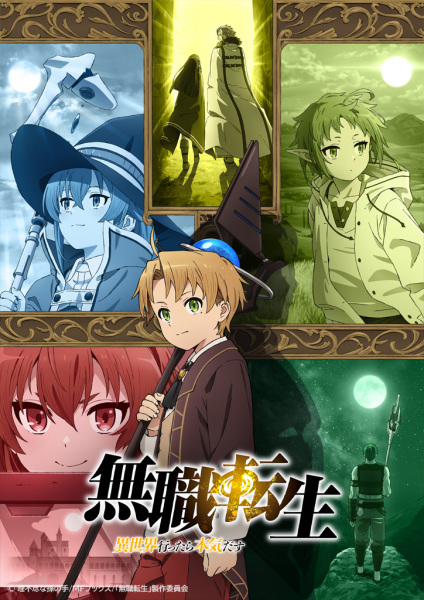
Mushoku Tensei
Is Mushoku Tensei worth watching?
Yes, it's worth watching. Anime Codex rates Mushoku Tensei 8.26 out of 10 — scored on six criteria (story, characters, themes, world-building, animation, and cultural impact), not crowd votes. 36th of 226 on the Codex rubric — top 16% of the catalogue. The crowd rates it 0.06 higher than the rubric does — the Codex is harder on it than on 19% of the catalogue.
Where to watch
What the data says
Computed from the Codex rubric across the whole catalogue.
Summary
Mushoku Tensei stands as the isekai that raised the genre's ceiling, pairing Studio Bind's exceptional debut animation with a coming-of-age narrative that treats reincarnation as a chance for painful self-repair rather than frictionless wish-fulfillment. Its greatest strength is honesty: Rudeus is deliberately flawed—cowardly, lecherous, haunted by his hikikomori past—and the show earns his gradual growth through concrete trials like the Fittoa teleportation disaster rather than granting it. The Six-Faced World is densely and consistently built, with a legible magic system and seeded lore that reward patient viewers. Direction and score are top-tier, shifting effortlessly from idyllic domestic warmth to genuine catastrophe. Its weaknesses are twofold: as a partial cut of a much longer story, the 11-episode run ends mid-journey without a fully self-contained climax, and its refusal to resolve Rudeus's perversion leaves the redemption arc somewhat morally muddy for viewers who find that framing indulgent rather than interrogative. Judged against the best of seinen isekai, it is a near-benchmark work—technically superlative, thematically braver than its peers, and character-driven in a genre often accused of shallow protagonists—held just short of the top tier by its incomplete arc structure and unresolved tonal tensions.
Criterion breakdown
Story & narrative
The first cour builds patiently from Rudeus's rebirth through the Roxy tutelage arc into the Fittoa region teleportation disaster, using a coming-of-age structure rather than plot spectacle. The pacing is deliberate and confident, though the narrative is clearly a partial cut of a longer journey, ending mid-momentum after the Rijika arc with Ruijerd and Eris rather than delivering a self-contained arc climax. It earns high marks for the mangaka-like control of scope and the seamless tonal shift from idyllic childhood to catastrophe.
Character writing & growth
Rudeus is a genuinely uncomfortable protagonist—the show refuses to sanitize his perversion or his cowardice, most pointedly in the panic-attack flashbacks to his hikikomori funeral and his freezing during the teleport crisis. His growth is incremental and hard-won rather than heroic, and the supporting cast (Roxy's insecurity, Sylphiette's timidity, Eris's volatility, Paul's flawed fatherhood) are written with real interiority. It stops short of a 9 only because Eris and Ruijerd's arcs are still early in their development by episode 11.
Themes & emotional resonance
The core theme—that a wasted life can be redeemed through the difficult work of facing one's past rather than escaping it—is handled with unusual honesty for an isekai, refusing easy wish-fulfillment. The 'take a step forward' motif and Rudeus's confrontation with his own trauma during the Fittoa disaster give the show emotional weight most genre entries lack. The persistent framing of his lechery as unresolved rather than fully interrogated slightly undercuts the redemption arc's cleanliness.
World-building & power system
Studio Bind renders the Six-Faced World with rare density: the mana-based magic system with incantation-versus-chantless casting, the demon-race politics, and the geography that pays off in the mass-teleportation catastrophe all feel internally consistent and lived-in. The magic operates on legible, escalating rules rather than plot convenience, and the setting's history is seeded early rather than exposited. It's a genuinely original take on isekai world-building, elevated above the genre's usual game-menu templates.
Animation & direction
Studio Bind's debut production is a technical showcase—fluid character acting, painterly backgrounds, and standout spectacle in the Supard village flashback and the teleport-storm sequence. Direction by Manabu Okamoto uses restrained framing for the quiet childhood beats and unleashes scale for the disaster, while the sound design and Yoshiaki Fujisawa score anchor the emotional peaks. This is among the best-looking isekai productions ever made and the single strongest element of the show.
Cultural impact
Frequently cited as the isekai that legitimized the genre for skeptics and set a new visual benchmark, it drove significant discourse both for its craft and for its willingness to depict an unlikable protagonist. Its massive MAL following (1.5M+ members, 8.32 average) reflects genuine impact, though its cultural footprint remains largely genre-internal rather than crossing into mainstream anime canon.
Synopsis (from MAL)
Despite being bullied, scorned, and oppressed all of his life, a 34-year-old shut-in still found the resolve to attempt something heroic—only for it to end in a tragic accident. But in a twist of fate, he awakens in another world as Rudeus Greyrat, starting life again as a baby born to two loving parents. Preserving his memories and knowledge from his previous life, Rudeus quickly adapts to his new environment. With the mind of a grown adult, he starts to display magical talent that exceeds all expectations, honing his skill with the help of a mage named Roxy Migurdia. Rudeus learns swordplay from his father, Paul, and meets Sylphiette, a girl his age who quickly becomes his closest friend. As Rudeus' second chance at life begins, he tries to make the most of his new opportunity while conquering his traumatic past. And perhaps, one day, he may find the one thing he could not find in his old world—love. [Written by MAL Rewrite]
Ranked nearby

Explore rankings
Discussion
Set a display name above to post.
Loading discussion…