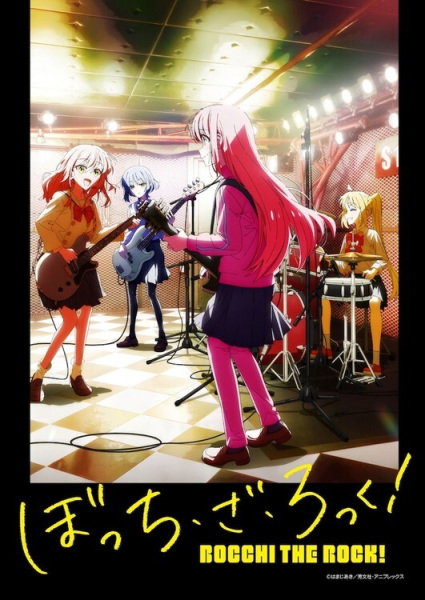
Bocchi the Rock!
Is Bocchi the Rock! worth watching?
Yes, it's worth watching. Anime Codex rates Bocchi the Rock! 8.36 out of 10 — scored on six criteria (story, characters, themes, world-building, animation, and cultural impact), not crowd votes. 29th of 226 on the Codex rubric — top 13% of the catalogue. The crowd rates it 0.37 higher than the rubric does — the Codex is harder on it than on 39% of the catalogue.
Where to watch
What the data says
Computed from the Codex rubric across the whole catalogue.
Summary
Bocchi the Rock! is among the finest music-focused slice-of-life works of its era, distinguished less by narrative ambition than by the precision of its central character study and the audacity of its direction. Bocchi Gotou is a remarkably authentic portrait of crippling social anxiety, and the series earns its emotional beats by letting her grow in small, believable increments rather than magically overcoming her nature. CloverWorks' constantly shifting animation styles—claymation, sketch, live-action collage—transform internal panic into inventive spectacle, while the grounded Shimokitazawa live-house setting lends unusual authenticity. Its performance sequences, especially the finale's broken-string improvisation, land with real force. The weaknesses are those of its genre: the plot is a familiar band-formation arc with minimal external stakes, and secondary members Ryou and Nijika are less deeply explored than Bocchi and Kita. Rapid comedic pacing occasionally undercuts emotional moments. Judged against the best of the CGDCT and music-slice-of-life space, however, it excels through craft and sincerity rather than plot mechanics. Its cultural impact—tourism, music sales, and 'bocchi' becoming shorthand for relatable anxiety—cements its status. It is a definitive-tier execution of a modest premise, and one of the standout titles of 2022.
Criterion breakdown
Story & narrative
The narrative follows a conventional band-formation arc—Bocchi joining Kessoku Band, first live shows, the summer festival, and the culminating Starry performances—which is structurally familiar for the music-CGDCT space. What elevates it is the tight episodic focus on incremental milestones (busking to fund gear, the school festival in the finale) rather than manufactured drama, though the plot itself rarely surprises and coasts on charm more than stakes. The absence of any real conflict beyond Bocchi's internal anxiety keeps it pleasant but narratively low-tension.
Character writing & growth
Bocchi is one of the most precisely rendered social-anxiety portraits in the demographic—her spiraling internal monologues, the dissociation gags, and her small but genuine steps (playing the bottleneck slide solo during a broken string, busking alone) chart believable growth without curing her. The supporting trio is well-differentiated: Nijika's earnest leadership, Ryou's deadpan freeloading, and Kita's extroverted vulnerability each get texture, and Kita's admiration for Ryou adds real relational depth. The only weakness is that Ryou and Nijika receive less interior development than Bocchi and Kita.
Themes & emotional resonance
The show treats social anxiety with unusual sincerity for a comedy, framing Bocchi's dream of connection as both aspirational and genuinely painful. The recurring theme that self-expression through music can be a bridge for those who cannot express themselves in words lands emotionally, especially in her solo busking arc and the broken-string improvisation. It occasionally undercuts its own emotional beats with rapid-fire gags, but the resonance remains authentic rather than saccharine.
World-building & power system
As a slice-of-life, its 'setting depth' lies in the specificity of the Shimokitazawa live-house music scene—Starry as a venue, the economics of ticket quotas, gear, and busking are rendered with authentic detail rare in the genre. The internal consistency of the band's slow skill progression and the grounded portrayal of amateur performance give it originality beyond generic school settings. It doesn't build a large world, but the niche it does build is credible and lived-in.
Animation & direction
CloverWorks' direction is the show's standout achievement—Bocchi's anxiety is visualized through wildly shifting media (claymation, pencil sketches, live-action photo collage, melting textures) that externalize her psychology inventively rather than decoratively. The performance sequences, particularly the finale, use rotoscoped, expressive guitar animation and dynamic staging that sell the music viscerally. This experimental visual language elevates otherwise ordinary scenes and defines the show's identity.
Cultural impact
The show became a breakout hit, driving real-world tourism to Shimokitazawa, boosting guitar sales, and turning Kessoku Band's music into charting releases with genuine mainstream traction. 'Bocchi' entered wider fandom vocabulary as shorthand for relatable social anxiety, and its meme-heavy visual gags spread widely, giving it outsized cultural footprint for a single-cour title.
Synopsis (from MAL)
Yearning to make friends and perform live with a band, lonely and socially anxious Hitori "Bocchi" Gotou devotes her time to playing the guitar. On a fateful day, Bocchi meets the outgoing drummer Nijika Ijichi, who invites her to join Kessoku Band when their guitarist, Ikuyo Kita, flees before their first show. Soon after, Bocchi meets her final bandmate—the cool bassist Ryou Yamada. Although their first performance together is subpar, the girls feel empowered by their shared love for music, and they are soon rejoined by Kita. Finding happiness in performing, Bocchi and her bandmates put their hearts into improving as musicians while making the most of their fleeting high school days. [Written by MAL Rewrite]
Ranked nearby

Explore rankings
Discussion
Set a display name above to post.
Loading discussion…