Anime Like Parasyte: The Maxim: 5 the Rubric Says You'll Love, Ranked by Critical Proximity
Fans of Parasyte: The Maxim respond to its strongest criteria — character psychology, tight escalating story, body-horror world logic — and these five picks deliver the same qualities, ranked by how close their critical profile sits to it, not by vibes.
Fans of Parasyte: The Maxim respond to its strongest criteria — character psychology, tight escalating story, body-horror world logic — and these five picks deliver the same qualities, ranked by how close their critical profile sits to it, not by vibes.
Madhouse's 2014 adaptation of Iwaaki Hitoshi's manga is not remembered because Migi is cute or because "Next to You" was a bold soundtrack choice — it is remembered because Shinichi Izumi's slow emotional deadening after his mother's death is one of the most carefully tracked psychological arcs in modern seinen. That is what the Codex is grading when it lands Parasyte: The Maxim at 7.93, and that is the criterion any recommendation has to answer to.
What Actually Carries Parasyte on the Rubric
The MyAnimeList crowd puts Parasyte at 8.32. The Codex is a third of a point cooler, and the reason is legible in the scorecard: cultural weight lands at 7.5 (a respected modern classic, not a genre-defining landmark), world-building sits at 7.5 (great biology, thin societal reach), animation clocks 7.7 (visceral morphing, divisive aesthetic choices). What actually holds the show up is character at 8.3 — Shinichi's numbing, Migi's quiet drift toward affection, Tamura Reiko's transformation from cold predator to self-sacrificing mother — and story at 8.0, escalating from body-horror survival to the Hirokawa mayoral conspiracy without losing its thematic spine. Themes at 7.8 rounds out the top tier: the meditation on humans as the true parasite, occasionally didactic but genuine.
So the question for anime like Parasyte: The Maxim isn't "what else has body horror." It's: what else builds a protagonist whose humanity is the actual variable, inside a story that escalates from intimate to systemic, with a moral thesis that refuses to flatter you? The five picks below are ranked by how close their Codex profiles sit to that answer.
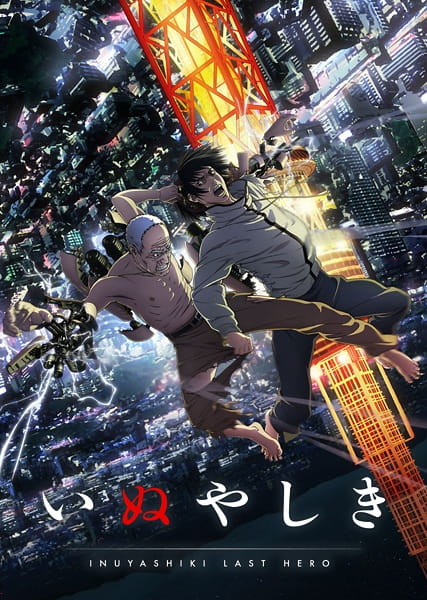
5. Inuyashiki — Codex 6.35
Hiroya Oku's 2017 MAPPA adaptation is the most literal Parasyte descendant on this list: an ordinary Tokyo life ruptured by a body-altering event, followed by a moral asymmetry between the two people it happens to. Ichirou Inuyashiki gets machine-god power and uses it to heal terminal cancer patients. Hiro Shishigami gets the same power and uses it to murder families for stimulation. That's the same design pattern as Shinichi/Migi split across two hosts.
The Codex sits Inuyashiki at 6.35 against Parasyte's 7.93, and the gap is honest. Themes at 7.0 do most of the work — the show has a real argument about what a person chooses when the physical constraints of being human are removed. But world-building slumps to 5.5 (the cyborg premise never accumulates rules the way Parasyte's parasites do), and character at 6.0 can't touch Shinichi's arc. Watch it for the moral binary, not for the writing that connects it.
4. Tokyo Ghoul — Codex 6.93
The comparison writes itself and is also the shallowest one on this list, which is why it isn't higher. Ken Kaneki, like Shinichi, becomes a hybrid — half-ghoul instead of half-parasite — and spends Studio Pierrot's 2014 twelve episodes negotiating whether his humanity survives the invasion. The body-horror grammar, the identity crisis, the predator-among-humans conceit all rhyme with Iwaaki's book.
The Codex has Tokyo Ghoul at 6.93, and the scorecard tells you exactly where the resemblance breaks. Cultural impact is 8.5 — this show's footprint outstrips Parasyte's, full stop. Themes at 7.5 and world at 7.0 track. But story collapses to 6.5 (an adaptation that runs from its own source material) and animation to 6.0 (Pierrot's censored, muted action). Parasyte at least respects its own biology in every fight. Tokyo Ghoul respects its aesthetic more than its plot.
3. Gungrave — Codex 8.23
This is where the rankings start rewarding what actually made Parasyte work. Madhouse's 2003 Gungrave opens with a sci-fi framing device and then, for roughly twenty episodes, forgets it — becoming instead a decades-spanning character study of Brandon Heat and Harry MacDowell, two friends who drift into opposite moral positions inside a criminal organization. Character at 9.0, themes at 8.5, story at 8.5. That is a shape Parasyte fans will recognize immediately: the show is a scorecard built almost entirely on the human writing, with the genre element receding into background texture.
The Codex weighted score is 8.23 against Parasyte's 7.93, and Gungrave is the closer match to what carries Parasyte than any body-horror title on this list. Same studio, incidentally — Madhouse also handled Iwaaki's adaptation, and the directorial patience with slow psychological deformation is a house strength. If you loved Shinichi's arc, this is the recommendation the numbers actually endorse.
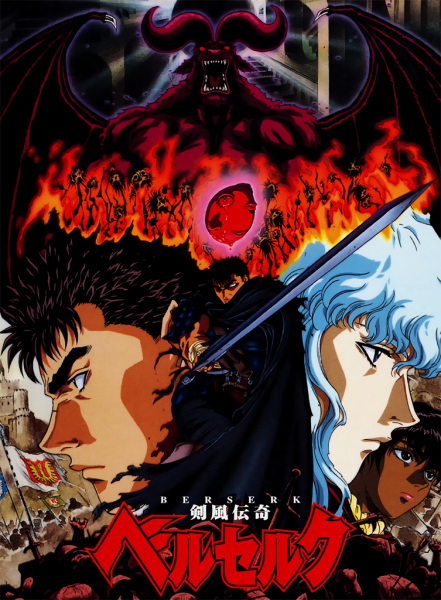
2. Berserk (1997) — Codex 8.53
OLM's 25-episode 1997 adaptation of Miura's manga is the Golden Age Arc and nothing else, and that constraint is its virtue. Guts and Griffith's relationship is a character-and-themes engine calibrated exactly the way Parasyte's Shinichi-Migi bond is: two beings whose logics initially oppose each other, whose growing intimacy is the story, and whose eventual moral rupture is the point.
The Codex lands Berserk at 8.53 — character 9.0, themes 9.0, story 8.5. The animation number is 6.5, and honestly, the 1997 production shows every one of its budgetary compromises. But the rubric doesn't flatter sakuga at the expense of writing, which is why this scorecard clears Parasyte's 7.93 decisively. If Tamura Reiko's arc was the moment Parasyte became something more than a monster show for you, the Eclipse is the same lever pulled harder.
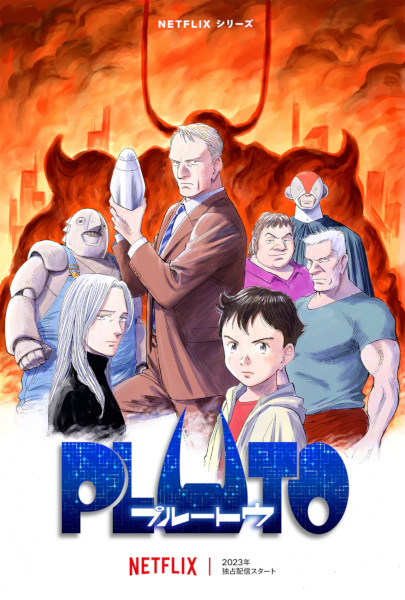
1. Pluto — Codex 8.96
Studio M2's 2023 eight-episode adaptation of Urasawa's Tezuka reworking is the highest recommendation on this list because it is the show that most rigorously executes what Parasyte gestures toward. Themes 9.3, story 9.2, character 9.0. It interrogates what separates person from monster with the philosophical precision Parasyte's Hirokawa monologue reaches for and doesn't quite hold. The parallel to how the Codex reads Master Keaton is worth noting — Urasawa's writing rewards the rubric's biases toward accumulated character work and moral rigor.
Codex 8.96 against Parasyte's 7.93. This is a show that will make you rewatch Parasyte and see the seams more clearly — Uragami's tacked-on placement, the Goto fight's environmental cheat. That is not an argument against Parasyte. It's the argument for how much further this same design language can be pushed by a writer working at Urasawa's ceiling.
The Counter-Argument: Isn't Body Horror the Actual Draw?
The honest opposition here is that Parasyte fans came for the flesh-blade morphing, the Migi facial contortions, Madhouse rendering the parasites' physics with unsettling consistency — and that recommending Pluto and Gungrave over, say, another visceral horror show misreads what people actually watched Parasyte for.
The rubric disagrees, and specifically. Animation is Parasyte's third-lowest criterion at 7.7. Cultural impact and world-building both sit at 7.5. If body horror were the load-bearing element, those numbers would be higher and character wouldn't be leading the scorecard by six-tenths of a point. The show is remembered as a modern classic because Shinichi's mother dies and something in him doesn't come back. Everything else is scaffolding.
Verdict
Rank recommendations by scorecard proximity to what actually carries a show, and the list stops looking like a genre-match exercise and starts looking like a critical map. Pluto, Berserk, and Gungrave clear Parasyte on the rubric because they push harder on the exact criteria — character, themes, story — that Iwaaki's work leans on. Watch them in that order and Parasyte gets larger, not smaller, in retrospect.
Featured in the Codex




More from The Codex
The Seven Deadly Sins Is a 6.60 Wearing a 7.60 Costume: A One-Point Gap Earned by Groping Gags and Convenient Flashbacks
The Seven Deadly Sins scores 6.60 on the Codex against MyAnimeList's 7.60 because the crowd is grading a Netflix breakout and a Ban-and-King friendship, not the 24 episodes A-1 Pictures actually broadcast in 2014.
The 10.0 That Built a Sunday: How Sazae-san's Cultural Score Carries a 6.58 Scorecard
Sazae-san is a case study in how a single criterion — cultural — can define how a show is remembered, and the 10.0 the Codex hands Eiken's 1969 institution is doing every bit of the heavy lifting its other five scores refuse to.
The Sebastian Problem: Why Black Butler Sits 1.10 Below Its MAL Line and the Crowd Refuses to Notice
Black Butler (Kuroshitsuji) posts a 1.10-point gap between MyAnimeList's 7.65 and the Codex 6.55 because the crowd is grading Sebastian's silhouette and a Phantomhive aesthetic, not the anime-original finale A-1 Pictures actually shipped in 2009.
Discussion
Set a display name above to post.
Loading discussion…