Anime Like Monster: 5 the Rubric Says You'll Love, Ranked by Critical Proximity
Fans of Monster respond to its strongest criteria — a 9.7 on character, a 9.5 story, Urasawa's 9.3 thematic spine — and these five picks deliver the same qualities, ranked by how close their critical profile sits to it, not by vibes.
Fans of Monster respond to its strongest criteria — a 9.7 on character, a 9.5 story, Urasawa's 9.3 thematic spine — and these five picks deliver the same qualities, ranked by how close their critical profile sits to it, not by vibes.
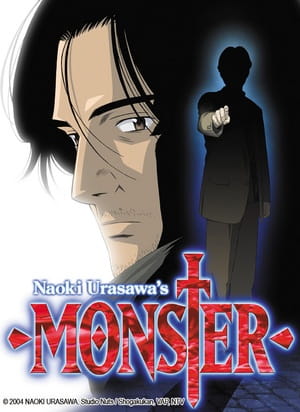
Monster is the show people reach for when they want to prove anime can hold a novel's weight, and the Codex 9.24 is not sentimental about why. Naoki Urasawa's 74-episode Madhouse production earns a 9.7 on character and a 9.5 on story before anything else — Tenma's moral collapse from careerist surgeon to fugitive gunman, Johan's psychological menace, Lunge's obsessive interior life. That is what a recommendation list for Monster has to match. Not "dark seinen." Not "smart thriller." The specific criteria.
What Monster Actually Scores On
The consensus read of Monster is that it's slow, prestige-coded, and "adult" — a shorthand MyAnimeList's 8.89 encodes without unpacking. The Codex breakdown is more precise about where the value lives. Character sits at 9.7 because Urasawa writes one-episode figures with the same interiority he gives Eva Heinemann's arc from vindictive ex-fiancée to broken witness. Story sits at 9.5 because the Kinderheim 511 threads and the Red Rose Mansion reveals are seeded across a decade of in-world time without losing cohesion. Themes clock in at 9.3 on the strength of the "Nameless Monster" picture book alone. World-building lands at 8.8 for the grounded post-Cold War Germany geography. Madhouse's restrained animation is an 8.2 — good, not the point.
Any anime like Monster has to hit at least two of those top three criteria — character, story, themes — with a comparable weight. Not adjacent vibes. Comparable rubric numbers. The five below are ranked by how close their profile sits to Monster's, starting with the one that shares its DNA outright.
Master Keaton — The Other Urasawa Adaptation Madhouse Made
Codex 7.77. Same mangaka. Same studio. The overlap is not coincidental — it's the closest structural sibling Monster has in the medium.
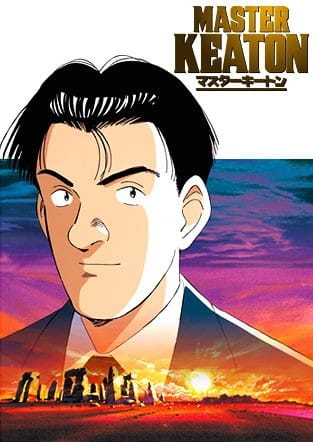
Master Keaton is what Urasawa was doing before Monster, and the 24-episode 1998 Madhouse production carries the same humanist thesis at a lower gear. Character scores 8.0 on Taichi Hiraga-Keaton's insurance-investigator-slash-archaeologist duality — a protagonist whose empathy for strangers is the whole engine of the show, the way Tenma's is. World-building at 8.2 outperforms most of the seinen shelf on the strength of its European travelogue realism, the same verisimilitude Monster gets credit for in its 8.8. Themes land at 7.9 on the value-of-a-life throughline Urasawa cannot stop writing about.
The 7.77 sits below Monster because story (7.8) is episodic by design and cultural (6.5) never crossed over. But if you loved Monster for how it treated its supporting cast — the drifters, the villagers, the widow in a border town — Master Keaton is the same authorial hand doing the same work in miniature.
Pluto — The Urasawa Thesis at 8 Episodes
Codex 8.96. Studio M2's 2023 adaptation is the highest-scoring recommendation on this list because it inherits Urasawa's rubric shape almost line for line.
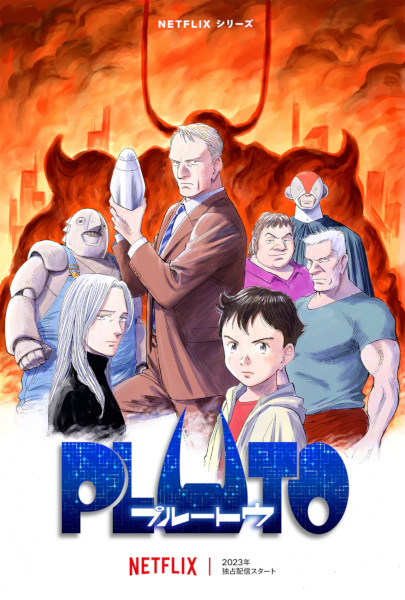
Story lands at 9.2 — a compressed murder mystery that reworks Tezuka's "World's Strongest Robot" arc into an interrogation of grief, war memory, and mechanical personhood. Themes come in at 9.3, matching Monster exactly, because Pluto is asking the same question — whether monsters are born or made — through Gesicht's fractured investigation and Atom's confrontation with what he was rebuilt into. Character at 9.0 is a hair under Monster's 9.7, and that's the honest gap: eight episodes cannot build Lunge, Grimmer, and Eva. What Pluto does have is a protagonist whose moral erosion under trauma reads as Tenma's spiritual cousin.
Cultural at 7.8 is the sole soft spot, and it's a release-recency issue more than a quality one. If Monster's 9.5 story score is what pulled you through 74 episodes, Pluto is the tightest version of that pull the medium has produced since.
Maison Ikkoku — The 9.0 Character Score in a Different Key
Codex 8.37. This is the pick that surprises people, and it shouldn't.
Maison Ikkoku scores 9.0 on character, matching Pluto and sitting just 0.7 under Monster. Rumiko Takahashi's 96-episode Studio Deen romance is a character study that happens to be a romcom, the way Monster is a character study that happens to be a thriller. Godai's stumbling passage into adulthood and Kyoko's widowhood are drawn with the same novelistic patience Urasawa gives Eva — small humiliations, years of them, no shortcuts. Themes score 8.7 because Takahashi is genuinely interested in what grief does to the ability to love again, and the show refuses to hurry her.
Story at 8.5 and cultural at 8.0 back it up. Studio Deen's 6.5 animation is the ceiling — this is 1986 television production and it looks it — but Monster's own 8.2 animation says loud enough that animation is not what you came for. You came for people written with interiority. Maison Ikkoku has that in the same proportion, wearing a different genre coat.
Re:Zero — Character-First Psychological Horror in Genre Drag
Codex 8.50. The isekai framing is a filter that keeps a lot of Monster viewers out. It shouldn't.
Re:Zero's character score of 9.0 is the reason it's on this list — Subaru's psychological disintegration across the Roswaal manor loops and the Sanctuary trial is the closest thing post-2010 anime has produced to Tenma's moral vertigo. Story at 8.5 and themes at 8.5 handle the trauma-loop machinery with more rigor than the genre's reputation implies. White Fox's 8.0 direction earns the dread. This is a show about a man breaking under the weight of what he's seen and choosing to keep going anyway — the exact register Monster works in when Tenma stands over Johan in the Red Rose Mansion.
World-building at 7.5 is the honest drag, and it's why Re:Zero sits below Pluto here. Fantasy set-dressing is not Urasawa's grounded Düsseldorf. But if you rank Monster by character above all — and the 9.7 says you should — Re:Zero delivers the payload.
Inuyashiki — The Weakest Pick, and Still on the List
Codex 6.35. The lowest number on this page, and it earns its slot on a specific criterion, not the whole scorecard.
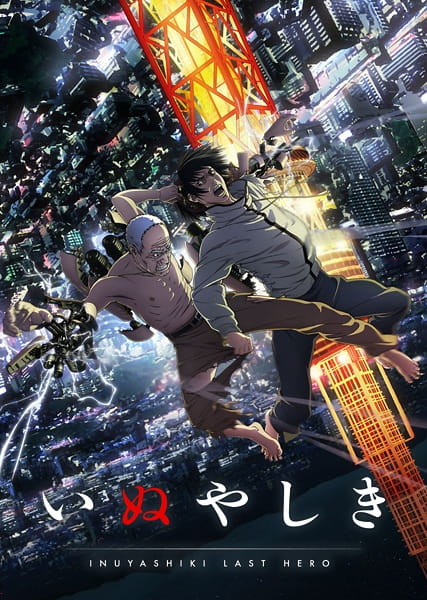
Inuyashiki's themes score of 7.0 is doing the work. Hiroya Oku's 11-episode MAPPA production sets an aging salaryman against a teenage sociopath and asks — with less finesse than Monster and more brutality — whether monstrousness is chosen. Hiro Shishigami is a cheap Johan by design; the show knows it. What Inuyashiki has that most edgy seinen doesn't is a genuine ethical question underneath the carnage: what does an ordinary man owe strangers?
Story at 6.5 and character at 6.0 are real limitations — this is not a novel, it's a pulp comic run tight. But the gap between what MAPPA shipped and what fans project onto shows like this is smaller than usual, because Inuyashiki has the honesty to make its villain hollow on purpose. Watch it after Monster, not before, and treat it as the thematic postscript.
The Counter-Argument: Why Not Paranoia Agent, Not Ergo Proxy, Not 20th Century Boys
The strongest objection to this list is what's missing. Kon's psychological horror, Ergo Proxy's noir, Urasawa's own 20th Century Boys — each has a plausible claim to Monster's neighborhood. The rubric answer is that critical proximity is not thematic proximity. A show that vibes like Monster but scores 7.2 on character is not the recommendation. A show that scores 9.0 on character in a romcom key — Maison Ikkoku — is. This is the same discipline applied to any-genre recommendation work: rank by the numbers that produced the love, not the aesthetic that surrounded it.
Monster's 9.24 is a character-and-story score wearing a thriller costume. These five, in this order, are the closest critical profiles the Codex catalogue offers. Watch Pluto first if you want the tightest hit. Watch Master Keaton if you want more Urasawa. Watch Maison Ikkoku if you trusted the rubric enough to get this far.
Featured in the Codex




More from The Codex
The Seven Deadly Sins Is a 6.60 Wearing a 7.60 Costume: A One-Point Gap Earned by Groping Gags and Convenient Flashbacks
The Seven Deadly Sins scores 6.60 on the Codex against MyAnimeList's 7.60 because the crowd is grading a Netflix breakout and a Ban-and-King friendship, not the 24 episodes A-1 Pictures actually broadcast in 2014.
The 10.0 That Built a Sunday: How Sazae-san's Cultural Score Carries a 6.58 Scorecard
Sazae-san is a case study in how a single criterion — cultural — can define how a show is remembered, and the 10.0 the Codex hands Eiken's 1969 institution is doing every bit of the heavy lifting its other five scores refuse to.
The Sebastian Problem: Why Black Butler Sits 1.10 Below Its MAL Line and the Crowd Refuses to Notice
Black Butler (Kuroshitsuji) posts a 1.10-point gap between MyAnimeList's 7.65 and the Codex 6.55 because the crowd is grading Sebastian's silhouette and a Phantomhive aesthetic, not the anime-original finale A-1 Pictures actually shipped in 2009.
Discussion
Set a display name above to post.
Loading discussion…