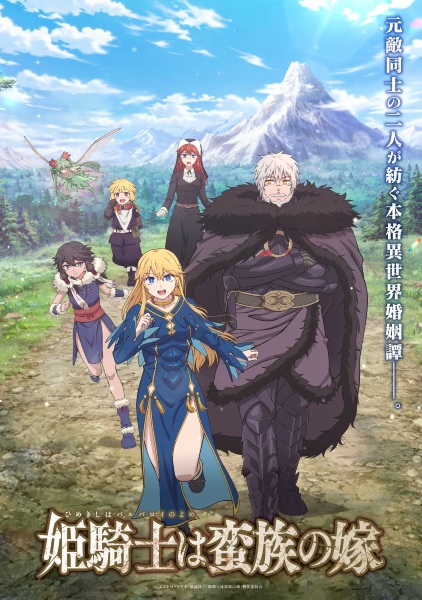
The Warrior Princess and the Barbaric King
Is The Warrior Princess and the Barbaric King worth watching?
Mixed — depends what you want. Anime Codex rates The Warrior Princess and the Barbaric King 6.30 out of 10 — scored on six criteria (story, characters, themes, world-building, animation, and cultural impact), not crowd votes. 194th of 226 on the Codex rubric — bottom 15% of the catalogue. The crowd rates it 0.50 higher than the rubric does — the Codex is harder on it than on 47% of the catalogue.
Where to watch
Trailer
What the data says
Computed from the Codex rubric across the whole catalogue.
Summary
The Warrior Princess and the Barbaric King is a competent, surprisingly gentle romantic fantasy that quietly subverts the exploitation its synopsis promises. Its greatest strength is Serafina herself, a defeated knight whose journey from wanting death to rediscovering agency carries real emotional weight, anchored by expressive character animation from Jumondou. The culture-clash premise between chivalric West and steppe-coded East provides a pleasant if shallow backdrop. Judged against the best romance-driven shonen and adjacent works, however, its weaknesses are clear: the show consistently chooses reassurance over tension, softening both its 'barbarian' king and the inherent power imbalance of a prisoner-bride scenario rather than confronting them honestly. The geopolitical war meant to provide stakes stays abstract, the mid-season pacing sags into episodic misunderstandings, and Galahan's gruff-but-tender arc resolves too tidily. Animation and direction are clean but unambitious, with sparse action. It is a solidly above-average entry for fans of political-marriage romance who want comfort over edge, but it lacks the narrative ambition, thematic courage, or visual distinction that would elevate it beyond a pleasant, forgettable seasonal watch. Good but flawed, and held back chiefly by its reluctance to engage its own premise.
Criterion breakdown
Story & narrative
The captured-knight-turned-bride premise is executed with more restraint than its lurid synopsis threatens, with the early episodes wisely subverting Serafina's expectation of torture into political marriage intrigue. However, the narrative leans heavily on episodic misunderstandings between Serafina and the king Galahan rather than building meaningful escalation, and the East-West war that should anchor the stakes remains frustratingly abstract through twelve episodes. The pacing sags mid-season once the initial culture-clash hook is spent.
Character writing & growth
Serafina is the show's strongest asset: her transition from suicidal defeated warrior to someone relearning agency is given genuine interior weight, particularly in the episode 4 sequence where she refuses ceremonial protection to prove her own competence. Galahan, by contrast, is a softer-than-advertised 'barbarian' whose gruffness-hides-tenderness arc is conventional and resolves too neatly. Supporting players like the rival clan envoy add texture but rarely escape their functional roles.
Themes & emotional resonance
The show gestures at dignity, captivity, and reclaiming selfhood after defeat, and Serafina's struggle to define worth beyond combat occasionally lands with real feeling. But it undercuts these themes by softening the inherent power imbalance of a prisoner-bride scenario rather than confronting it, opting for reassurance over discomfort. The 'otherworldly marriage' framing keeps the emotional stakes safely romantic rather than genuinely interrogating coercion.
World-building & power system
The contrast between the rigid chivalric West and the steppe-coded Eastern barbarian society offers a serviceable backdrop, with nice incidental detail in the clan's mounted customs and feast hierarchies in episodes 5-6. Yet the setting rarely achieves internal depth beyond aesthetic shorthand, and the geopolitics driving the war feel like a pretext rather than a coherent system. It is functional fantasy worldbuilding rather than distinctive.
Animation & direction
Jumondou delivers clean, consistent character art with particular care given to Serafina's armor and expressive range, and the marriage-ceremony episode shows tasteful color and lighting work. Action is sparse and competently staged but never spectacular, with the war flashbacks relying on stills and limited motion. Direction is steady and unambitious, prioritizing dialogue framing over visual flourish.
Cultural impact
With 86k MAL members and a 6.8 average, the show has found a solid josei-romance-adjacent audience operating under a shonen label, but it has not generated significant discourse or fandom momentum. It rides the popular 'captured/political marriage' subgenre wave without distinguishing itself enough to lead it.
Synopsis (from MAL)
"Just kill me!" These are the words of Serafina de Lavillant, the strongest female knight in the West. After being defeated in a war with the East, she has become a prisoner of the barbarians! What awaits the captive Serafina is a life of revenge, torture, and humiliation... or so she thought! What she is offered instead is a marriage to the barbarian king?! An intriguing tale of otherworldly marriage is about to begin! (Source: Kodansha)
Ranked nearby



Explore rankings
Discussion
Set a display name above to post.
Loading discussion…