Ranma ½
Is Ranma ½ worth watching?
Mixed — depends what you want. Anime Codex rates Ranma ½ 6.22 out of 10 — scored on six criteria (story, characters, themes, world-building, animation, and cultural impact), not crowd votes. 200th of 226 on the Codex rubric — bottom 13% of the catalogue. The crowd rates it 1.57 higher than the rubric does — the Codex is harder on it than on 92% of the catalogue.
Where to watch
Streaming availability varies by region — check your local services.
What the data says
Computed from the Codex rubric across the whole catalogue.
Summary
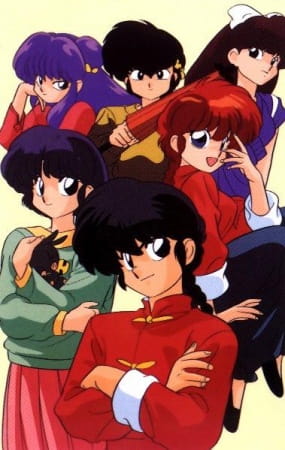
Ranma ½ is a landmark martial-arts romantic comedy whose gender-swap curse and arranged-marriage premise generated an entire genre lineage of harem and rival-driven comedies. Its strengths are a vivid, instantly readable ensemble — Ranma, Akane, Ryoga, Shampoo, Kuno — and Rumiko Takahashi's reliably sharp farce, animated with expressive, elastic comic timing by Studio Deen. Beneath the bickering, the Ranma-Akane relationship carries real warmth that occasionally surfaces in quieter episodes. The show's limitations are structural and tonal: at 161 episodes it runs almost purely on episodic formula, resetting its status quo endlessly, developing characters horizontally rather than allowing growth, and ultimately ending without resolving its central engagement. Its thematically rich gender premise is treated as gag material rather than explored, and humor that leans on dated homophobia and fat-shaming has aged poorly. The animation, strong early, sags under the demands of a long broadcast run. Judged as shonen comedy rather than narrative drama, it succeeds at exactly what it sets out to do, and its cultural footprint — as a gateway anime and template for romantic comedy — far exceeds its merely-good craftsmanship. A foundational, endlessly rewatchable, but creatively static classic.
Criterion breakdown
Story & narrative
Ranma ½ is structurally a sitcom: the gender-curse premise and arranged engagement provide an evergreen engine, but across 161 episodes the show runs almost entirely on the 'new rival/new fiancée arrives, fight ensues, status quo resets' formula. Arcs like the Phoenix/Saffron material in the manga never get a satisfying anime resolution, and the series simply stops rather than concludes, leaving the central engagement unresolved. Takahashi's farce is reliably constructed but rarely builds escalating stakes, which caps its narrative ambition.
Character writing & growth
The ensemble is the show's real strength: Ranma's macho insecurity, Akane's pride masking vulnerability, and the parade of distinct foils — Ryoga's directionless devotion, Shampoo's predatory affection, Mousse's blind obsession, Kuno's delusion — are sharply drawn and consistently funny. The Ranma-Akane relationship has genuine tenderness beneath the bickering, with episodes like the ice-skating and martial-arts-dining bits revealing real warmth. The flaw is stasis: characters are revealed rather than grown, and almost no one meaningfully changes across the run.
Themes & emotional resonance
The gender-swap conceit gives Ranma ½ surprising thematic texture for late-80s shonen, poking at masculinity, performance, and how Ranma is treated differently in each body. But the show treats this almost entirely as comedic fodder rather than developing it, and recurring gags lean on the era's casual homophobia and fat-shaming. The Ranma-Akane affection lands emotionally more often than the show's ideas do.
World-building & power system
The Jusenkyo cursed-springs premise is genuinely inventive and internally consistent — every curse follows the cold-water/hot-water rule, enabling endless variation (Genma's panda, Shampoo's cat, Ryoga's piglet). The 'Anything-Goes' martial arts framing lets Takahashi spin absurd disciplines like martial-arts tea ceremony, rhythmic gymnastics, and figure skating into the setting. It's more comic conceit than deep world, but the originality of the premise is high for its demographic.
Animation & direction
Studio Deen's production is solid for late-80s/early-90s TV, with expressive, elastic character acting well-suited to Takahashi's slapstick and clean fight choreography in early arcs. However, quality is uneven across the long run, with noticeable budget dips, recycled animation, and increasingly static late episodes. The bright character designs and energetic comic timing are the standouts rather than the technical polish.
Cultural impact
As one of Takahashi's flagship works alongside Urusei Yatsura and Inuyasha, Ranma ½ was a foundational gateway title for Western anime fandom in the 90s and codified the harem/martial-arts-comedy template that countless later series imitated. Its gender-fluid premise also made it an early touchstone for queer and trans readings of anime. Its influence on romantic-comedy conventions outstrips its modest critical reputation.
Synopsis (from MAL)
Ranma Saotome is a top-class martial artist and prodigy at the Saotome "Anything-Goes" school of martial arts. While training in China, he and his father meet a terrible fate when they accidentally fall into a cursed spring. Now, Ranma is cursed to turn into a girl when splashed with cold water, and only hot water can turn him back into a boy. Things are only complicated further when Ranma discovers that his father has arranged for him to marry one of Soun Tendo's three daughters in order to secure the future of the Tendo dojo. Though Soun learns of Ranma's predicament, he is still determined to go ahead with the engagement, and chooses his youngest daughter Akane, who happens to be a skilled martial artist herself and is notorious for hating men. Ranma ½ follows the hilarious adventures of Ranma and Akane as they encounter various opponents, meet new love interests, and find different ways to make each other angry, all while their engagement hangs over their head. [Written by MAL Rewrite]
Ranked nearby



Explore rankings
Discussion
Set a display name above to post.
Loading discussion…