The 6.78 That Keeps Sunako in Chibi Mode: Why The Wallflower's MAL Reputation Outruns Its Rubric
The Wallflower scores 6.78 on the Codex against MyAnimeList's 7.71 — a 0.93-point gap earned when the crowd rewards a subversive premise and forgets that Nippon Animation never actually resolves it.
The Wallflower scores 6.78 on the Codex against MyAnimeList's 7.71 — a 0.93-point gap earned when the crowd rewards a subversive premise and forgets that Nippon Animation never actually resolves it.
Sunako Nakahara is the best anti-shoujo lead of her decade, and Nippon Animation spent twenty-five episodes making sure she stayed exactly where they found her. That's the tension the Codex 6.78 is trying to name. The gap between Yamato Nadeshiko Shichi Henge's reputation and its rubric score is the story — what the crowd rewards on premise, the criteria refuse to grade past on execution.
The Consensus, and Where It Breaks
MyAnimeList has this show at 7.71 across 170,000+ members, a number that codes it as a beloved cult shoujo and one of the reliable "reverse-harem but different" recommendations. The consensus is not wrong about what The Wallflower is — it is genuinely different, genuinely funnier than Fruits Basket-adjacent contemporaries, genuinely willing to make its heroine a horror-obsessed weirdo who bleeds from the nose at "bright creatures." The consensus is wrong about what The Wallflower does with that difference. Ask whether Yamato Nadeshiko Shichi Henge is overrated and the honest answer is: overrated by 0.93 points of unresolved premise. The crowd is grading the concept and the character design; the rubric is grading twenty-five episodes of Nippon Animation refusing to move the plot forward.
Story: The Episodic Loop That Never Closes
Codex story lands at 6.0, and the justification is structural rather than aesthetic. The Wallflower runs on a gag-of-the-week engine — haunted-house tests, forced beauty makeovers, the summer festival episode, ghost-hunting excursions — and each cycle terminates in a status-quo reset. This is a specific narrative choice, not an accident. Tomoko Hayakawa's manga was still ongoing in 2006 (and would run until 2015, thirty-six volumes), so the anime committed to an open-ended tease rather than an arc.
The cost of that choice is Kyohei and Sunako. Across all twenty-five episodes, their relationship inches forward with a stinginess that would embarrass most shoujo of the era. The show can't let Sunako become anything because becoming would kill the joke; it can't let Kyohei confess because confession would collapse the rent-free-contract premise. So we get twenty-five near-misses. It's the same trap Komi Can't Communicate falls into with OLM's episodic structure — a premise that generates infinite skits and zero momentum, and a crowd score that rewards the skits while pretending the momentum is somewhere in the subtext.
Character: The Two Leads Are Real, the Other Three Are Furniture
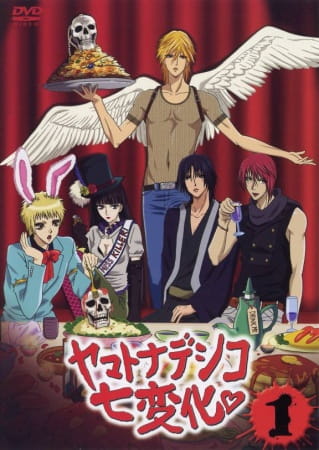
Character is where the Codex is most generous — 7.0 — and it's earned by two people. Sunako's rejection of femininity is not a costume; it's structural. The anatomical dolls, the horror-movie fixation, the "creature of darkness" silhouette gag that Nippon Animation stages whenever she's forced into a social scene — these are consistent characterizations, not aesthetic gestures. Kyohei is the show's real thematic move: a bishonen who resents his beauty, who has been objectified and cornered by his looks in ways that mirror Sunako's wound from the opposite direction. Their symmetry is the best-written thing in the adaptation.
But Ranmaru, Takenaga, and Yuki are archetypes. Ranmaru is the womanizer, Takenaga is the intellectual with the shy girlfriend, Yuki is the crybaby. They rotate through their designated beats and never complicate them. In a five-hander cohabitation comedy, three of the five being static costs the show more than the rubric fully punishes. Worse: Sunako's core trauma — the childhood cruelty that named her ugly — gets revisited across the run without ever getting metabolized. Growth here is gestural. She has the same breakdown in episode 22 that she had in episode 4, dressed slightly differently.
Themes: The Sharpest Idea in the Show, Played for Laughs
Themes score highest — 7.5 — and this is where The Wallflower's defenders have their strongest ground. The inversion is real. Kyohei being harassed, stalked, and physically threatened for his face is not window dressing; it's the show's cleanest thematic statement, and it inverts the gendered gaze that most reverse-harems trade on uncritically. The idea that beauty is isolating, that being seen as beautiful is a form of being unseen, gives the comedy an actual spine.
The problem is tonal. Nippon Animation almost never lets the pathos sit. Sunako's retreat into her darkened room, her refusal to be looked at — this is the material of a genuinely melancholy show, and it gets played for chibi deformation and sight gags roughly 90% of the time. When the show does let a serious beat land — the flashback moments, the rare episodes where Kyohei's exhaustion cracks through — you can feel what The Wallflower could have been. Then the aunt shows up, the plot resets, and Sunako is a skull-headed silhouette again.
Animation and World: Mid-2000s TV, Punching at Its Weight in the Gags Only
Animation lands at 6.5, and the split is honest. The comedic direction is well-timed: the super-deformed "creature of darkness" versus the rare "beautiful reveal" is the show's signature visual joke, and Nippon Animation stages it with genuine craft — the timing of Sunako's silhouette drop, the glowing bishonen auras played as horror-movie lighting, the chibi cuts that hit their beats. Outside the gags, the linework is modest and the backgrounds are the standard mid-2000s TV floor. Non-comedic scenes get very little animation budget, which compounds the show's other problem: the emotional beats already struggle to land, and now they're being carried by static shots.
World-building at 6.5 is generous. The mansion premise and the aunt's rent-free contract are a clever forced-cohabitation engine — that's genuine originality of setup. But internal logic is loose, the aunt functions as a walking deus ex machina, and the gothic-occult aesthetic is a mood rather than a constructed setting. Compare it to the shoujo entries that do build a world — this show is competing on tone, not on architecture.
The Steelman: Cultural Specificity and the Anti-Cinderella Case
The strongest defense: The Wallflower matters because nothing else in 2006 shoujo was doing this. The anti-Cinderella framing is genuinely uncommon, Sunako is genuinely the only lead of her kind, and the show's cultural score of 6.0 undersells its niche importance as a reference point in reverse-harem discourse. The MAL 7.71 is partly a vote for that specificity — for the fact that a shoujo lead was allowed to be off-putting and stay off-putting.
The Codex doesn't disagree that this matters. It disagrees that specificity of premise substitutes for execution. The show never broke into mainstream landmark status, the anime stops well short of the manga's eventual thirty-six volumes, and the cultural footprint is real but bounded. Compare the pattern to Kaichou wa Maid-sama!, whose rubric profile the Codex tracks against similar shoujo-romcom peers, or to Fushigi Yûgi, whose reverse-harem foundational status runs 0.77 points ahead of its execution score — the same pattern shows up. Premise gets banked. Execution gets forgotten.
Verdict
The Wallflower is a 6.78 with a great character, a sharp theme it refuses to sit inside, and a story engine designed to prevent resolution. That's not a bad show — it's a specific show being graded on specific failures. The 0.93-point gap to MAL is the crowd rewarding Sunako's design and the concept of Kyohei's wound; the rubric is grading the twenty-five episodes Nippon Animation actually broadcast around them.
Featured in the Codex



More from The Codex
The Seven Deadly Sins Is a 6.60 Wearing a 7.60 Costume: A One-Point Gap Earned by Groping Gags and Convenient Flashbacks
The Seven Deadly Sins scores 6.60 on the Codex against MyAnimeList's 7.60 because the crowd is grading a Netflix breakout and a Ban-and-King friendship, not the 24 episodes A-1 Pictures actually broadcast in 2014.
The 10.0 That Built a Sunday: How Sazae-san's Cultural Score Carries a 6.58 Scorecard
Sazae-san is a case study in how a single criterion — cultural — can define how a show is remembered, and the 10.0 the Codex hands Eiken's 1969 institution is doing every bit of the heavy lifting its other five scores refuse to.
The Sebastian Problem: Why Black Butler Sits 1.10 Below Its MAL Line and the Crowd Refuses to Notice
Black Butler (Kuroshitsuji) posts a 1.10-point gap between MyAnimeList's 7.65 and the Codex 6.55 because the crowd is grading Sebastian's silhouette and a Phantomhive aesthetic, not the anime-original finale A-1 Pictures actually shipped in 2009.
Discussion
Set a display name above to post.
Loading discussion…