Anime Like Kaichou wa Maid-sama!: 5 the Rubric Says You'll Love, Ranked by Critical Proximity
Fans of Kaichou wa Maid-sama! respond to its strongest criteria — a 7.5 on Misaki, a 7.0 cultural footprint, a shoujo-romcom hook that lands its comedic timing — and these five picks deliver the same qualities, ranked by how close their critical profile sits to it, not by vibes.
Fans of Kaichou wa Maid-sama! respond to its strongest criteria — a 7.5 on Misaki, a 7.0 cultural footprint, a shoujo-romcom hook that lands its comedic timing — and these five picks deliver the same qualities, ranked by how close their critical profile sits to it, not by vibes.
Misaki Ayuzawa is the reason Kaichou wa Maid-sama! outlives its own thin plotting. J.C.Staff's 26-episode 2010 adaptation lands a Codex 6.70 not because Hiroaki Sakurai reinvented the shoujo-romcom camera — he didn't — but because Hiro Fujiwara built a heroine whose class resentment, workaholic pride, and refusal to be visibly tired do heavy structural work the second cour otherwise wastes. The show earns its keep on character (7.5) and cultural footprint (7.0). Everything else is competent.
What the Rubric Actually Rewards Here
The MyAnimeList 7.99 that shadows Maid-sama! flatters the parts of the show that are least interesting critically. The crowd is grading Usui — an overpowered fantasy object whose interiority the anime withholds so completely he reads as an enigma rather than a person — and rewarding the bungee-jump confession beat as if the surrounding structure earned it. It didn't. The Yumesaki Academy rivalry and butler-cafe detour are recurring "someone discovers or threatens the secret" loops that never escalate, and the Tora Igarashi and noble-family plotting is gestured at, then abandoned because the anime stops well short of the manga.
What actually carries the show: Misaki's workaholic pride, her father's abandonment shaping her class insecurity, Maid Latte as a workplace with texture (the manager, the coworkers) rather than a fanservice gag. So the recommendations that follow are ranked by how tightly their strongest criteria track the same axes — character-first shoujo with a sincere labor or class or emotional-armor engine underneath the comedy. Not by mood-board proximity.
1. Itazura na Kiss — When the Rubric Says "Same Shape, Rougher Finish"
Itazura na Kiss sits at a Codex 6.19 — below Maid-sama!, and honestly ranked here because the critical profile is the closest structural match on the list. TMS Entertainment's 2008 25-episode adaptation runs the same engine: prickly, hardworking heroine (Kotoko) circling a genius, unreachable love interest (Naoki), episodic escalation that keeps finding new social contexts to test the couple in. Both shows post identical themes scores (6.0), both post story around 6.5, and both suffer the same character asymmetry — the girl is dimensional, the boy is a wall.
What Itazura na Kiss trades away is animation. Its 5.0 there is meaningfully rougher than J.C.Staff's clean 6.5, and Naoki is even more emotionally sealed than Usui. If Misaki's exhaustion and pride were what pulled you in, Kotoko's decade-spanning persistence — the show follows her past graduation and into married life, which Maid-sama! never gets to attempt — is the closest thing the medium offers to seeing that engine keep running.
2. Lovely Complex — The Version Where the Character Score Goes Up
If Maid-sama! frustrates you because Misaki is doing all the emotional labor while Usui coasts on being perfect, Lovely Complex is the corrective. Toei Animation's 2007 24-episode run scores a Codex 7.68 — a full point over Maid-sama! — and the gap lives almost entirely in character (8.5 vs. 7.5) and themes (7.8 vs. 6.0). Risa Koizumi and Atsushi Otani are both dimensional in a way Usui refuses to be; their height gap isn't a gimmick, it's a running interrogation of how public embarrassment shapes private feeling.
The Kansai-dialect performance work carries a specificity Maid-sama!'s Tokyo shoujo neutrality never reaches for. And the labor Risa performs — emotional, mostly, but also the physical comedy of being read as a joke everywhere she goes — pays off with the same sincerity Maid-sama! finds in Misaki's Maid Latte shifts. Toei's animation (6.5) is right in line with J.C.Staff's. This is the pick where the rubric agrees with you if you already suspected Maid-sama! was leaving points on the table.
3. Special A — The Honest Downgrade
Special A is on this list because the shape is nearly identical and the execution is not. Gonzo's 2008 24-episode adaptation posts a Codex 5.68 — the lowest here — and it's earned. Hikari Hanazono is a Misaki-adjacent heroine (relentlessly competitive, allergic to losing, orbiting a genius boy who refuses to be beaten), but the class-insecurity motor Maid-sama! actually respects gets swapped for cartoonish ultra-wealth, and the world score (5.0) reflects a setting that never bothers to feel real.
Recommended honestly: if you want the Maid-sama! premise-shape without any of the structural surprises, this is the closest silhouette. Character (6.3) and story (5.8) both trail Maid-sama! by roughly a point, and the cultural footprint (4.5) tells you why nobody talks about it anymore. It's the palate cleanser slot, not the elevation.
4. Kareshi Kanojo no Jijou — The Themes Score Maid-sama! Wishes It Had
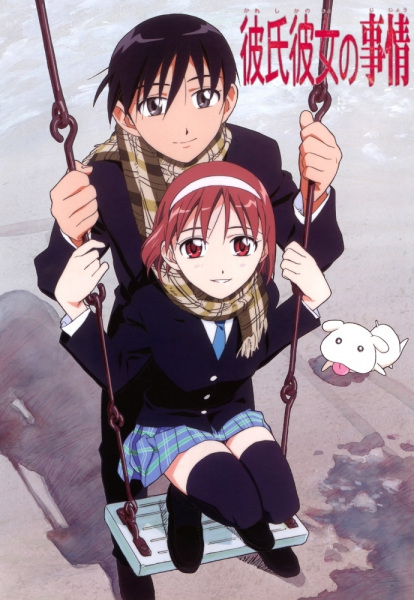
Hideaki Anno's 1998 Gainax adaptation of Masami Tsuda's manga scores a Codex 7.83, and the reason to put Kareshi Kanojo no Jijou this high on a Maid-sama! list is exactly the criterion Maid-sama! is weakest on: themes (8.0 vs. 6.0). Yukino Miyazawa is Misaki with the mask made explicit — a heroine whose public perfection is a performance she knows is a performance, and the show interrogates that performance rather than treating it as a comedic engine. Anno's direction pushes an 8.0 on animation that J.C.Staff's clean-but-conventional 6.5 can't touch — freeze frames, text cards, live-action inserts, the whole Gainax toolkit repurposed for a shoujo interior.
Character (8.5) is the other reason. Arima is the anti-Usui: his interiority is the whole point of the back half, not a withheld tease. If you liked Maid-sama! for the parts where Misaki's armor slipped, Kare Kano is the show that treats that slippage as its actual subject.
5. Ouran High School Host Club — The Cultural Score Maid-sama! Reached For
Ouran High School Host Club posts a Codex 7.83 and is the show Maid-sama! is quietly compared to at every turn — the genre-shifting shoujo-romcom prestige entry Maid-sama!'s 7.0 cultural score gestures toward without matching. Ouran clears a 9.0 there. Bones' 2006 26-episode production under Takuya Igarashi runs the same class-inversion premise Maid-sama! runs — working-class protagonist embedded in an elite institution, performing a role for economic reasons — but does it with a satirical self-awareness Fujiwara's material never quite reaches.
Character parity is the tell: Ouran posts 8.5 to Maid-sama!'s 7.5, and Haruhi's flat refusal to perform gender the way the Host Club expects is the exact critical move Maid-sama! avoids when it declines to interrogate Usui's persistence. Animation 8.0 vs. 6.5. Themes 7.5 vs. 6.0. This is the ceiling of the subgenre, and the reason it sits at position five isn't quality — it's that Ouran is a satirical mode away from Maid-sama!'s earnestness, which is why the character-first Kare Kano and Lovely Complex track closer to what Misaki actually is.
The Case for Not Ranking This Way
The obvious counter is that Itazura na Kiss (6.19) being ranked above Ouran (7.83) inverts the quality order and looks perverse. It does. The defense is that the brief is critical proximity to Maid-sama!'s profile, not absolute quality — and Itazura na Kiss's story-character-themes triangle sits within a rounding error of Maid-sama!'s, while Ouran's satirical register operates in a different mode entirely. If you want the best shoujo-romcom on the list, watch Ouran or Kare Kano first. If you want the show whose rubric shape is nearest to what you already like, Itazura na Kiss is the honest answer.
Verdict
Maid-sama!'s 6.70 is a character-and-culture score with a merely competent production wrapped around it, and the five recommendations above are ordered by how tightly their critical profiles hug that same shape — not by how much you'll enjoy them in absolute terms. Watch Itazura na Kiss for the closest silhouette, Lovely Complex and Kare Kano for the version where the character and themes scores climb, Ouran for the ceiling. Special A is the mirror that shows you what Maid-sama! got right by comparison.
Featured in the Codex






More from The Codex
The Seven Deadly Sins Is a 6.60 Wearing a 7.60 Costume: A One-Point Gap Earned by Groping Gags and Convenient Flashbacks
The Seven Deadly Sins scores 6.60 on the Codex against MyAnimeList's 7.60 because the crowd is grading a Netflix breakout and a Ban-and-King friendship, not the 24 episodes A-1 Pictures actually broadcast in 2014.
The 10.0 That Built a Sunday: How Sazae-san's Cultural Score Carries a 6.58 Scorecard
Sazae-san is a case study in how a single criterion — cultural — can define how a show is remembered, and the 10.0 the Codex hands Eiken's 1969 institution is doing every bit of the heavy lifting its other five scores refuse to.
The Sebastian Problem: Why Black Butler Sits 1.10 Below Its MAL Line and the Crowd Refuses to Notice
Black Butler (Kuroshitsuji) posts a 1.10-point gap between MyAnimeList's 7.65 and the Codex 6.55 because the crowd is grading Sebastian's silhouette and a Phantomhive aesthetic, not the anime-original finale A-1 Pictures actually shipped in 2009.
Discussion
Set a display name above to post.
Loading discussion…