The MARRIAGETOXIN Watch Order: Two Seasons, Bones Film, and What the Rubric Endorses at 7.08
Franchise watch-order confusion is real; this lays out the [MARRIAGETOXIN](/shows/marriagetoxin) entries in release order with what actually matters — one 13-episode Bones Film cour and a 2027 continuation that inherits its scorecard.
Franchise watch-order confusion is real; this lays out the MARRIAGETOXIN entries in release order with what actually matters — one 13-episode Bones Film cour and a 2027 continuation that inherits its scorecard.
Two-season shonen adaptations from a subsidiary studio rarely arrive with a clean release ledger, and MARRIAGETOXIN is unusual only in how compact its ledger actually is. There is no film, no OVA prologue, no short-form promotional cour to sequence around. There is a first season and a second season, released a year apart, and the entire watch-order question resolves in a sentence — which does not mean the ordering conversation is empty, because a 7.08 franchise entry deserves to be placed against what the rubric actually rewards and refuses.
The Consensus, and Where the Codex Departs
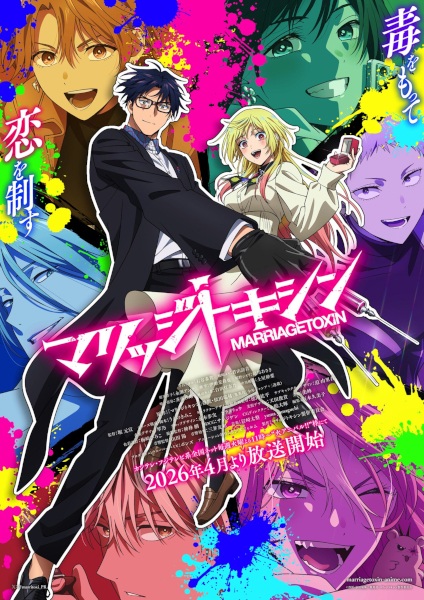
MyAnimeList lists the 2026 broadcast at 7.52, which is a polite number for a Bones Film production working in the assassin-romcom register — a shelf currently overcrowded and undertheorized. The aggregate score reads like a floor for a competent shonen premise with a legible hook, and the crowd is largely rewarding Bones Film's line quality and the central bit: a hitman forced into arranged-marriage interviews. Anime Codex scores the same 13-episode run at 7.08, and the 0.44-point gap is not an argument about whether the show is watchable. It is an argument about whether the premise's thematic payload — masculinity, contract, intimacy under duress — actually lands, or whether it stays a recurring gag with production polish on top.
That is the frame the MARRIAGETOXIN watch order lives inside. There are only two entries. Both are essential if you intend to watch the franchise; neither is optional in the way a recap film or a spinoff might be. The interesting work is deciding whether the first season, in isolation, is enough — and the rubric has a defensible answer.
MARRIAGETOXIN (TV, 13 episodes, 2026) — Essential
The first season is the entire load-bearing structure of the franchise as it currently exists on the Codex. Bones Film handles the adaptation, and the animation score of 7.4 is the highest single mark on the card — which is what you would expect from a Bones subsidiary working on a manga whose action beats depend on close-quarters choreography and comic timing rather than sustained sakuga set pieces. The character score at 7.3 comes in second, carried by Gero's tonal instability as a lead: the show is at its sharpest when the assassin protocol and the marriage-interview protocol are asked to coexist inside the same scene, and weakest when the episodic omiai structure resets the emotional stakes to zero.
Story lands at 7.0, which is the number that tells you what a 13-episode cour of an ongoing serialized manga can and cannot do. The season adapts an arc block rather than a complete narrative arm; the ending is a pause, not a resolution. Themes at 6.8 is the criterion doing the heaviest lifting against the Codex score — the show gestures at a real argument about masculine performance and emotional labor and then declines to prosecute it, preferring to return to the gag engine. World at 7.0 is fine and unremarkable: contemporary Japan with a hitman underworld pasted over it, no meaningful worldbuilding load. Cultural at 6.5 is where the franchise pays for being new and mid-tier — the footprint is not yet there, and may never be, in the way that would rewrite the scorecard the way a single high cultural mark did for Chibi Maruko-chan.
You watch season one first. There is no alternative reading order that improves the show.
MARRIAGETOXIN 2nd Season (TV, 2027) — Essential If You Finished Season One
The second season has not aired at time of writing and therefore does not carry a discrete Codex score; the 7.08 attaches specifically to the 2026 broadcast, not to the franchise as a projected whole. What can be said is structural. A second cour on a Bones Film shonen adaptation typically inherits the first season's directional signature and production pipeline, and the criteria most likely to shift are story and themes — the two lowest marks on the first-season card, and the two that a continuation is best positioned to move.
If season one's 6.8 on themes bothered you — and it should, because it is the criterion the show most obviously undersells — season two is the entry that either vindicates the premise or confirms that the gag engine is the ceiling. If season one's 7.0 on story bothered you, season two is where the arc block either resolves into something structurally satisfying or extends the pause. There is no version of engaging with this franchise where you watch season two without season one, and no reason to. The order is the release order; the release order is the only order.
Why There Is No Side Material to Sequence
Some franchises accumulate a promotional ecosystem that a watch-order guide has to triage — recap episodes, character-focused shorts, tie-in films that arrive between cours. MARRIAGETOXIN, as of the 2027 season announcement, has none of it. This is worth naming explicitly because readers arriving from franchises with sprawling ledgers — the kind of situation the One Piece watch order exists to untangle — should not expect hidden entries. There is the TV spine and nothing else. The absence is not a failure; it is a signal that the property has not yet earned the multi-format expansion that a stronger cultural score would justify.
The Counter-Argument: One Season Is Enough
The strongest case against watching season two runs like this. MARRIAGETOXIN's first cour is a self-contained tonal experiment. The premise lands in the pilot, the gag structure stabilizes by episode four, and the show demonstrates its full range by episode nine. A viewer who finishes the 2026 broadcast has seen what the show is willing to be. Continuing into 2027 is a bet on thematic escalation from a production that spent its first thirteen episodes declining to escalate, and the rubric's 6.8 on themes is a specific warning about that bet.
The rubric reads it differently for one reason. Story at 7.0 is a score assigned to an incomplete arc, and incomplete arcs are the criterion category most likely to move — up or down — when the continuation arrives. Refusing season two locks the franchise into its first-season card permanently, which is a defensible choice for a viewer with limited time but not a defensible critical position. You cannot argue the show fails to earn its thematic weight without watching the cour that might supply it.
Verdict
Watch MARRIAGETOXIN in release order: the 2026 Bones Film cour, then the 2027 continuation. The 7.08 attaches to season one and season one only, and it is a score that identifies a competent shonen production whose animation and character work carry a thematic argument the writing has not yet decided to prosecute. Season two is where the franchise either moves off that number or confirms it.
Featured in the Codex


More from The Codex
The Seven Deadly Sins Is a 6.60 Wearing a 7.60 Costume: A One-Point Gap Earned by Groping Gags and Convenient Flashbacks
The Seven Deadly Sins scores 6.60 on the Codex against MyAnimeList's 7.60 because the crowd is grading a Netflix breakout and a Ban-and-King friendship, not the 24 episodes A-1 Pictures actually broadcast in 2014.
The 10.0 That Built a Sunday: How Sazae-san's Cultural Score Carries a 6.58 Scorecard
Sazae-san is a case study in how a single criterion — cultural — can define how a show is remembered, and the 10.0 the Codex hands Eiken's 1969 institution is doing every bit of the heavy lifting its other five scores refuse to.
The Sebastian Problem: Why Black Butler Sits 1.10 Below Its MAL Line and the Crowd Refuses to Notice
Black Butler (Kuroshitsuji) posts a 1.10-point gap between MyAnimeList's 7.65 and the Codex 6.55 because the crowd is grading Sebastian's silhouette and a Phantomhive aesthetic, not the anime-original finale A-1 Pictures actually shipped in 2009.
Discussion
Set a display name above to post.
Loading discussion…