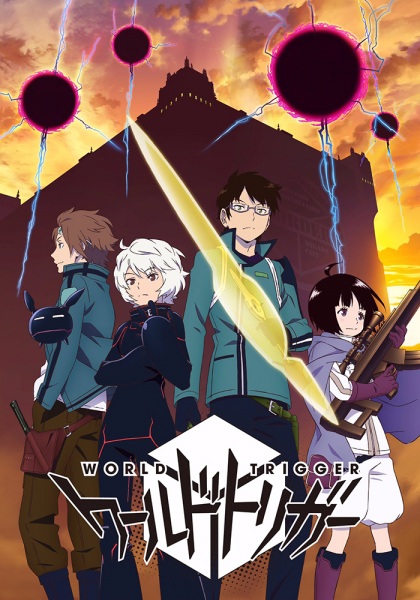
World Trigger
Is World Trigger worth watching?
Worth a look. Anime Codex rates World Trigger 7.30 out of 10 — scored on six criteria (story, characters, themes, world-building, animation, and cultural impact), not crowd votes. 110th of 226 on the Codex rubric — top 49% of the catalogue. The crowd rates it 0.29 higher than the rubric does — the Codex is harder on it than on 33% of the catalogue.
Where to watch
Trailer
What the data says
Computed from the Codex rubric across the whole catalogue.
Summary
World Trigger distinguishes itself within shonen by replacing power escalation with tactical depth, making it a thinking fan's battle series. Its greatest assets are the rigorously consistent Trigger system, the bail-out mechanic that sustains tension without lethal stakes, and a deep ensemble of squads whose clashes resemble competitive sport more than brawls. Osamu Mikumo is a refreshingly ordinary protagonist whose growth comes from foresight and teamwork rather than hidden talent, and the Rank Wars arc showcases some of the genre's smartest combat writing. The show's weaknesses are real: Toei's 2014 animation is stiff and budget-limited, often conveying brilliant strategy through static diagrams rather than fluid action, and an early filler stretch reflects production strain. The deliberate pacing and exposition-heavy opening cour test patience, and the sprawling cast can feel like tactical pieces more than emotionally fleshed-out characters, leaving the show's emotional resonance muted compared to its cerebral satisfaction. It never achieved mainstream cultural reach but earned a loyal following and an eventual sequel. For viewers who prize strategy, internal consistency, and ensemble cohesion over spectacle and catharsis, World Trigger is a quietly excellent and underrated entry in its demographic.
Criterion breakdown
Story & narrative
World Trigger's narrative strength lies in its strategic patience — the Large-Scale Invasion arc and especially the extended Rank Wars constitute one of shonen's most rigorously logical competitive structures, where outcomes hinge on positioning, terrain, and team composition rather than power spikes. The pacing is deliberate to a fault, however; the first cour leans heavily on exposition and Osamu's slow setup, and the anime's first run notoriously stalled into filler around the Aftokrator aftermath. The B-Rank Wars elevate the show considerably, but reward viewers who tolerate a slow burn.
Character writing & growth
The show's refusal to make Osamu a hidden prodigy is its boldest choice — he is genuinely mediocre, and his growth is incremental and earned through tactics and grit rather than awakenings, a sharp contrast to typical Jump protagonists. The ensemble is the real triumph: dozens of agents like Jin, Kuga, Chika, Tamakoma's roster, and rival squads (Tachikawa, Suwa, Kage) each carry distinct combat philosophies and motives. The downside is that the enormous cast dilutes focus, and several characters get more screen time as tactical pieces than as emotionally developed people.
Themes & emotional resonance
World Trigger meaningfully interrogates competence, teamwork, and the value of weakness — Osamu's arc argues that limitations can be compensated by foresight and trust, which resonates differently from raw self-improvement narratives. Its handling of the Neighbor refugees and the morally gray Border politics adds welcome nuance about whether all aliens are enemies. Emotional resonance is comparatively muted, though; the show prizes cerebral satisfaction over gut-punch moments, and its restraint occasionally reads as emotional flatness.
World-building & power system
The Trigger system is one of shonen's most internally consistent power frameworks — the Trion mechanic, bail-out system that removes lethal stakes while preserving tension, and the strict role specialization (Attacker, Gunner, Sniper, Operator) create a battle logic closer to a sport or wargame than a brawl. Border's organizational structure, ranking system, and the geopolitical layering of multiple Neighbor nations give the setting genuine depth. The bail-out conceit cleverly lets Ashihara stage high-stakes combat without cheap deaths, making strategy paramount.
Animation & direction
This is the show's weakest pillar. Toei's 2014 production is frequently stiff, with limited animation, recycled cuts, and visibly budget-strained action that undercuts the brilliance of the choreography on the page. Direction is functional but rarely dynamic, and the early filler arc reflects production troubles; the manga's tactical clarity often survives in spite of, not because of, the animation, with battle positioning conveyed through static diagrams and narration.
Cultural impact
World Trigger enjoys a devoted niche following and respectable longevity, earning a 2021 sequel season after years of hiatus, which signals lasting fan loyalty. It never reached the mainstream cultural penetration of its Jump contemporaries, however, remaining a connoisseur's pick valued chiefly by fans of tactical, team-based combat rather than a genre-defining phenomenon.
Synopsis (from MAL)
When a gate to another world suddenly opens on Earth, Mikado City is invaded by strange creatures known as "Neighbors," malicious beings impervious to traditional weaponry. In response to their arrival, an organization called the Border Defense Agency has been established to combat the Neighbor menace through special weapons called "Triggers." Even though several years have passed after the gate first opened, Neighbors are still a threat and members of Border remain on guard to ensure the safety of the planet. Despite this delicate situation, members-in-training, such as Osamu Mikumo, are not permitted to use their Triggers outside of headquarters. But when the mysterious new student in his class is dragged into a forbidden area by bullies, they are attacked by Neighbors, and Osamu has no choice but to do what he believes is right. Much to his surprise, however, the transfer student Yuuma Kuga makes short work of the aliens, revealing that he is a humanoid Neighbor in disguise. [Written by MAL Rewrite]
Ranked nearby




Explore rankings
Discussion
Set a display name above to post.
Loading discussion…