Anime Like Ouran High School Host Club: 5 the Rubric Says You'll Love, Ranked by Critical Proximity
Fans of Ouran High School Host Club respond to its strongest criteria — a 9.0 cultural footprint, an 8.5 ensemble, Takuya Igarashi's 8.0 direction at Bones — and these five picks deliver the same qualities, ranked by how close their critical profile sits to it, not by vibes.
Fans of Ouran High School Host Club respond to its strongest criteria — a 9.0 cultural footprint, an 8.5 ensemble, Takuya Igarashi's 8.0 direction at Bones — and these five picks deliver the same qualities, ranked by how close their critical profile sits to it, not by vibes.
Ouran isn't beloved because it invented the reverse-harem — it's beloved because Takuya Igarashi weaponized chibi inserts, rose-petal cutaways, and tonal whiplash to make a parody load-bearing. The Codex has it at 7.83, and the number is doing exactly what the rubric wants it to: rewarding a 9.0 in cultural, an 8.5 in character, and an 8.0 in animation, while accepting a 7.0 story that treats the eight-million-yen debt as a joke it forgets on purpose. Anyone recommending you "anime like Ouran High School Host Club" on premise alone is missing what the show actually does.
What Ouran is actually scoring on
MyAnimeList sits Ouran at 8.16 with over a million members, and the crowd is broadly right about the shape of the show — they're just grading the memory. The Codex 7.83 pulls apart what that memory is made of. Haruhi's gender-indifferent pragmatism, Tamaki's flamboyant idiocy hiding a mother-shaped wound, the Hitachiin twins learning to exist as separate people — that's the 8.5 character line, and it's the single most transferable quality in a recommendation. The 9.0 cultural score is unrepeatable; almost nothing in shoujo has Ouran's meme longevity or its status as a Western gateway. So the picks below have to substitute somewhere else: sharper theme work, closer character interiority, or a directorial signature loud enough to compete with Igarashi's sparkle-and-rose grammar.
The list is ordered by critical proximity to Ouran's rubric profile — not by tone, not by studio, not by "you'll feel the same way." Two of these entries actually outscore Ouran on individual criteria the show cares about. One of them ties its total.
Lovely Complex — the 7.68 that matches Ouran on character
Lovely Complex is the closest critical neighbor Ouran has on this list, and the reason is simple: Toei's 2007 adaptation scores 8.5 on character — identical to Ouran — and 7.8 on themes, which is higher. Risa and Ootani's height-gap romcom is often mis-sold as a gag premise, and the 24-episode run does trade on that hook, but the interiority is real. Risa's refusal to be small about wanting something absurd — a boy shorter than her, and openly — sits closer to Haruhi's refusal to perform femininity than any surface-level comparison would suggest. Toei's animation ceiling is a 6.5, well below Bones' 8.0 on Ouran, and you'll feel it in the flatter compositions. But the 7.68 Codex score against Ouran's 7.83 is a fifteen-hundredths gap, and it's earned in the same criteria the source show wins on. If Ouran's ensemble is what kept you, Lovely Complex is the pick.
Kaichou wa Maid-sama! — the 6.70 that carries the archetype
Kaichou wa Maid-sama! sits at 6.70 on the Codex against MyAnimeList's 7.99, and the gap is instructive. J.C.Staff's 2010 adaptation is grading well on character (7.5) and cultural (7.0) — the two criteria that overlap most cleanly with Ouran's strongest lines. Misaki Ayuzawa is not Haruhi; she's the pointed inversion, a class-president perfectionist whose maid-cafe secret exists to be leveraged. But the show's comedic engine — a heroine who refuses to play the shoujo passivity script — is the same engine Ouran ran, and Usui reads as a Tamaki-adjacent watchtower character with the flamboyance dialed down and the surveillance dialed up. The 6.5 story and 6.5 animation scores tell you where the rubric departs from Ouran — J.C.Staff isn't Bones, and the plotting flattens after the cultural festival — but the archetype work lands. If you want the fuller breakdown, the Codex review of Maid-sama covers the 1.29-point gap in detail.
Itazura na Kiss — the 6.19 that holds the ensemble comedy
Itazura na Kiss is the point on this list where the Codex starts to diverge from the crowd. TMS Entertainment's 2008 adaptation scores 6.19, against a MyAnimeList 7.38, and the rubric is unsentimental about why: 5.5 world, 5.0 animation, 6.0 themes. The Kotoko-and-Naoki dynamic is the last full-form romantic-comedy shoujo of its exact vintage, and the 25-episode arc actually resolves its central relationship — something Ouran's truncated run pointedly does not do. That resolution is the trade. You lose Igarashi's directorial wit and Bones' polish; you gain a completed emotional arc between two characters whose class asymmetry echoes Haruhi's scholarship-student outsider status from a different angle. The 6.8 character score is where the connective tissue to Ouran lives.
Special A — the 5.68 that runs the archetype grid
Special A is the lowest-scoring pick on this list at 5.68, and the honesty of putting it here matters more than the number. Gonzo's 2008 adaptation is grading a 6.3 on character and a 5.8 on story, and the 4.5 cultural score is the rubric acknowledging that Special A's footprint is a fraction of Ouran's. What it does have is the archetype grid — a Hakusenkan of elite students sorted by type, a Hikari/Kei rivalry that plays the same class-and-competence game Haruhi runs against the Ouran hosts, and an ensemble structure that spotlights each of the seven S.A. members in rotation. That episodic character-by-character architecture is the specific formal move Ouran used to give real interiority to characters introduced as gags. Special A can't sustain it at Ouran's level. It runs the pattern anyway.
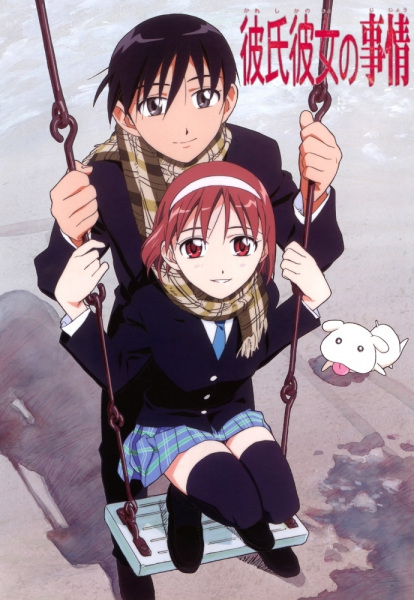
Kareshi Kanojo no Jijou — the 7.83 that ties Ouran outright
Kareshi Kanojo no Jijou matches Ouran's Codex score exactly — 7.83 to 7.83 — and it does it from a completely different direction. Gainax's 1998 Hideaki Anno adaptation posts an 8.5 on character (equal to Ouran), an 8.0 on themes (higher), an 8.0 on animation (equal), and a 7.0 story that, like Ouran, ends before its manga finished. The overlap with Ouran is the directorial signature: Anno's paper cutouts, text-card interludes, monochrome monologues, and formal collapse in the back half are doing what Igarashi's chibi whiplash and fourth-wall gags do — using visual grammar as emotional shorthand. The Yukino-and-Arima dynamic weaponizes performance and appearance-management the way Ouran weaponizes host-club roles. If you cared about Tamaki's mother-shaped wound or the twins' individuation arc, Kare Kano is the show that pushes those specific thematic buttons harder. It's the pick that will feel least like Ouran and grade closest to it.
The counter-argument: none of these has the cultural score
The strongest objection to this list is that Ouran's 9.0 cultural criterion is doing more load-bearing work in the 7.83 than any single episode of the show does, and none of these five clears a 7.0 on that line. Lovely Complex and Maid-sama tie at 7.0; Kare Kano scores 6.5; Itazura na Kiss 6.5; Special A a bare 4.5. If what you loved about Ouran was its status — the meme longevity, the cosplay afterlife, the gateway-drug reputation — no recommendation can replicate that, and pretending otherwise is dishonest. The rubric reads it differently because cultural footprint is retrospective; it's the shadow the show casts, not the show itself. Every entry here matches or exceeds Ouran on at least one of the criteria that describes what the show does on screen. That's the substitution the ranking is making.
The verdict
Order the recommendations by rubric proximity and Kare Kano wins outright, Lovely Complex follows on character parity, and Maid-sama, Itazura na Kiss, and Special A descend on decreasing overlap — exactly what the numbers say. Ouran's cultural score is unrepeatable; its character, theme, and animation work is not. Watch Kare Kano first.
Featured in the Codex





More from The Codex
The Seven Deadly Sins Is a 6.60 Wearing a 7.60 Costume: A One-Point Gap Earned by Groping Gags and Convenient Flashbacks
The Seven Deadly Sins scores 6.60 on the Codex against MyAnimeList's 7.60 because the crowd is grading a Netflix breakout and a Ban-and-King friendship, not the 24 episodes A-1 Pictures actually broadcast in 2014.
The 10.0 That Built a Sunday: How Sazae-san's Cultural Score Carries a 6.58 Scorecard
Sazae-san is a case study in how a single criterion — cultural — can define how a show is remembered, and the 10.0 the Codex hands Eiken's 1969 institution is doing every bit of the heavy lifting its other five scores refuse to.
The Sebastian Problem: Why Black Butler Sits 1.10 Below Its MAL Line and the Crowd Refuses to Notice
Black Butler (Kuroshitsuji) posts a 1.10-point gap between MyAnimeList's 7.65 and the Codex 6.55 because the crowd is grading Sebastian's silhouette and a Phantomhive aesthetic, not the anime-original finale A-1 Pictures actually shipped in 2009.
Discussion
Set a display name above to post.
Loading discussion…