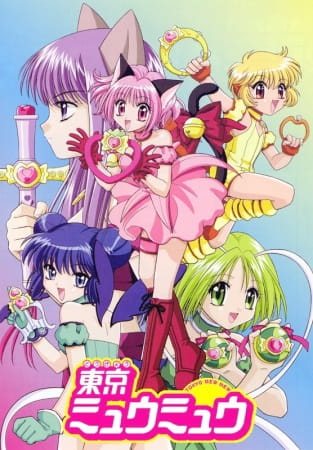
Tokyo Mew Mew
Is Tokyo Mew Mew worth watching?
Mixed — depends what you want. Anime Codex rates Tokyo Mew Mew 6.04 out of 10 — scored on six criteria (story, characters, themes, world-building, animation, and cultural impact), not crowd votes. 206th of 226 on the Codex rubric — bottom 10% of the catalogue. The crowd rates it 1.08 higher than the rubric does — the Codex is harder on it than on 76% of the catalogue.
Where to watch
Streaming availability varies by region — check your local services.
What the data says
Computed from the Codex rubric across the whole catalogue.
Summary
Tokyo Mew Mew is a solid, mid-tier magical-girl series notable chiefly for its inventive premise: heroines powered by endangered-animal DNA, fighting to protect an ecologically threatened Earth. That conservation angle and the species-specific power designs give it genuine originality within a crowded post-Sailor Moon landscape, and Ichigo makes for an endearing, relatable lead whose romance with Aoyama anchors the emotional appeal. The five-girl ensemble offers pleasant variety, even if most members receive limited individual development. Its weaknesses are typical of long-running TV magical-girl shows: a thin plot stretched across 52 episodes, a repetitive monster-of-the-week midsection, heavy reliance on reused transformation footage, and direction that is competent but unremarkable. The environmental themes are sincere but rarely explored with depth. Judged against the best of shoujo magical-girl anime, it falls short of genre landmarks but comfortably clears the bar of enjoyable, well-intentioned entertainment for its target audience. Its lasting cultural footprint—bolstered by international localization and a 2022 reboot—secures its place as a beloved, if not essential, entry. A charming watch for genre fans willing to forgive its padding and dated production values.
Criterion breakdown
Story & narrative
The premise of fusing endangered-species DNA into magical girls is a fresh hook within the genre, and the early episodes (Ichigo's transformation, the gradual recruitment of Mint, Lettuce, Pudding, and Zakuro) give the show a clear monster-of-the-week structure with mild escalation. However, the middle stretch sags badly with repetitive Chimera Anima battles, and the eco-aliens conflict driven by Kish, Pai, and Tart only gains real stakes near the finale. The 52-episode runtime is stretched thin against what is essentially a thin plot spine.
Character writing & growth
Ichigo is a likable, relatable lead whose insecurity over balancing her Masaya crush with hero duties grounds the show emotionally, and the contrast among the five girls (haughty Mint, timid Lettuce, energetic Pudding, aloof Zakuro) gives the ensemble decent texture. The Aoyama identity twist and Zakuro's standoffish recruitment arc are the strongest character beats. Still, most growth is surface-level, the supporting Mews get limited individual development, and the Ryou/Keiichiro romantic ambiguity never fully pays off.
Themes & emotional resonance
The environmental and endangered-species messaging is an unusual and genuinely sincere thematic core for a Nakayoshi title, tying the girls' powers directly to conservation. The recurring 'protecting the planet' motif and the aliens' grievance over a dying Earth add a layer of moral nuance rare in the genre. But the show rarely digs deep, mostly using ecology as flavor rather than a sustained emotional thread.
World-building & power system
The animal-DNA power system is the show's standout originality—each Mew's weapon and abilities are themed to her specific species (Iriomote cat, finless porpoise, etc.), which is more inventive than typical magical-girl gimmicks. Cafe Mew Mew as a base and the alien antagonists' homeworld backstory provide modest setting depth. Internal consistency is decent, though the science is hand-waved and the alien lore stays underdeveloped.
Animation & direction
Studio Pierrot delivers serviceable early-2000s TV animation with bright, appealing character designs and energetic transformation sequences, but the quality is inconsistent across 52 episodes with frequent reused stock footage for transformations and attacks. Direction is functional rather than distinctive, and battle choreography is repetitive. It looks dated even against contemporaries like Ojamajo Doremi.
Cultural impact
Tokyo Mew Mew enjoyed strong international reach, particularly through its English manga and the 'Mew Mew Power' adaptation, and remains a recognizable entry in the magical-girl revival between Sailor Moon and Pretty Cure. Its enduring fan affection and 2022 reboot (Tokyo Mew Mew New) confirm a lasting niche legacy, though it never reached genre-defining status.
Synopsis (from MAL)
Ichigo Momomiya expected her date with her crush, Masaya Aoyama, to have a more romantic ending than her falling asleep after she sees a vision of a cat entering her body. Things get even stranger when, the next day, she begins displaying cat-like behaviors such as an intense craving for fish. When Masaya is attacked by a monster, she discovers that she is able to transform into the cat-eared magical girl, Mew Ichigo. After she saves Masaya, two researchers named Ryou Shirogane and Keiichiro Akasaka approach her and reveal they had injected her with Iriomote Cat DNA in order to create a magical girl that can save the world from aliens. Ichigo is tasked with fighting these monsters, but saving the world proves to be just too much for Ichigo to handle by herself. Fortunately, she learns that there are four other girls just like her, and now, Ichigo must find them quickly before the aliens completely take over the planet. [Written by MAL Rewrite]
Ranked nearby





Explore rankings
Discussion
Set a display name above to post.
Loading discussion…