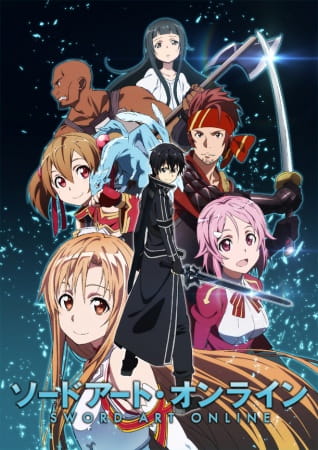
Sword Art Online
Is Sword Art Online worth watching?
Mixed — depends what you want. Anime Codex rates Sword Art Online 5.98 out of 10 — scored on six criteria (story, characters, themes, world-building, animation, and cultural impact), not crowd votes. 210th of 226 on the Codex rubric — bottom 8% of the catalogue. The crowd rates it 1.25 higher than the rubric does — the Codex is harder on it than on 84% of the catalogue.
Where to watch
What the data says
Computed from the Codex rubric across the whole catalogue.
Summary
Sword Art Online is a landmark shonen isekai whose influence far outstrips its execution. Its central hook — the lethal VRMMO of Aincrad, where logging out is impossible and death is permanent — is one of the most magnetic premises of its era, and A-1 Pictures backs it with strong production values and a memorable Yuki Kajiura score. When the show commits to self-contained emotional beats, like Sachi's death or the Yui subplot, it lands genuine resonance. But SAO consistently undercuts its own strengths: erratic pacing skips through Aincrad's hundred floors, Kirito's beta-tester invincibility drains tension, and the survival stakes rarely bite because named characters seldom die. The second half's Fairy Dance arc is a marked step down, reducing the capable Asuna to a captive princess and replacing existential dread with a generic fantasy rescue and a one-note villain. Measured against the best shonen adventure titles, it is a flawed but pivotal work — carried by premise, atmosphere, and cultural momentum rather than disciplined storytelling or character depth. Its historical importance to the isekai boom is undeniable, but its narrative and character writing keep it from the front rank of its demographic.
Criterion breakdown
Story & narrative
The Aincrad arc (episodes 1-14) has a genuinely gripping premise — permadeath in a VRMMO — but the show squanders it with erratic pacing, skipping years and floors in single episodes while the '10,000 players trapped' tension rarely feels lived-in. The Fairy Dance arc (episodes 15-25) collapses the survival stakes into a rescue plot where Asuna is reduced to a caged princess, and the Sugou subplot leans on cheap villainy. The strongest episode, 'The Red-Nosed Reindeer' (Sachi's death), shows what tighter, self-contained storytelling could have achieved throughout.
Character writing & growth
Kirito is a competent but flat protagonist whose beta-tester overpowered status removes most in-game tension; his growth is asserted rather than dramatized. Asuna is compellingly written in Aincrad as a capable co-lead but is stripped of agency in Fairy Dance, becoming a damsel to be saved — a significant regression. Supporting players like Klein, Silica, and Lisbeth get one-episode spotlights that hint at a richer cast the show never sustains.
Themes & emotional resonance
The series gestures at meaningful ideas — the blurring of virtual and real identity, mortality inside a game, found connection under duress — most effectively in the Yui subplot and Sachi's arc. But these threads are rarely developed with rigor; the death-game's existential weight is undercut by how rarely named characters actually die. Fairy Dance abandons thematic ambition almost entirely for melodrama.
World-building & power system
The NerveGear/full-dive VRMMO premise is the show's strongest asset, and Aincrad's floating-castle structure with its floor-by-floor progression is an evocative, original setting. However, the internal logic is inconsistent — the game's economy, respawn rules, and how thousands survive daily are underexplored — and the switch to ALfheim Online in Fairy Dance feels like a generic fantasy reskin that dilutes the distinctive premise.
Animation & direction
A-1 Pictures delivers polished, consistent production with Yuki Kajiura's evocative score elevating key scenes. Adachi Tomohiko's direction shines in set-pieces like the Gleam Eyes boss fight and Kirito's duel with Heathcliff, and the environmental art of Aincrad's floors is genuinely lush. Sword choreography is dynamic if occasionally reliant on flashy slow-motion finishers.
Cultural impact
SAO is arguably the defining isekai/VRMMO title of the 2010s, popularizing the 'trapped in a game' subgenre and inspiring a wave of imitators. Its enormous MAL membership (over 3.3 million) and multi-season franchise longevity confirm outsized reach, even as critical opinion remains sharply divided.
Synopsis (from MAL)
Ever since the release of the innovative NerveGear, gamers from all around the globe have been given the opportunity to experience a completely immersive virtual reality. Sword Art Online (SAO), one of the most recent games on the console, offers a gateway into the wondrous world of Aincrad, a vivid, medieval landscape where users can do anything within the limits of imagination. With the release of this worldwide sensation, gaming has never felt more lifelike. However, the idyllic fantasy rapidly becomes a brutal nightmare when SAO's creator traps thousands of players inside the game. The "log-out" function has been removed, with the only method of escape involving beating all of Aincrad's one hundred increasingly difficult levels. Adding to the struggle, any in-game death becomes permanent, ending the player's life in the real world. While Kazuto "Kirito" Kirigaya was fortunate enough to be a beta-tester for the game, he quickly finds that despite his advantages, he cannot overcome SAO's challenges alone. Teaming up with Asuna Yuuki and other talented players, Kirito makes an effort to face the seemingly insurmountable trials head-on. But with difficult bosses and threatening dark cults impeding his progress, Kirito finds that such tasks are much easier said than done. [Written by MAL Rewrite]
Ranked nearby
Explore rankings
Discussion
Set a display name above to post.
Loading discussion…