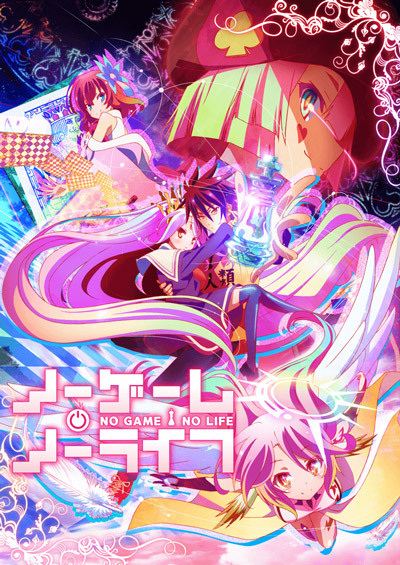
No Game No Life
Is No Game No Life worth watching?
Worth a look. Anime Codex rates No Game No Life 6.50 out of 10 — scored on six criteria (story, characters, themes, world-building, animation, and cultural impact), not crowd votes. 180th of 226 on the Codex rubric — bottom 21% of the catalogue. The crowd rates it 1.53 higher than the rubric does — the Codex is harder on it than on 92% of the catalogue.
Where to watch
What the data says
Computed from the Codex rubric across the whole catalogue.
Summary
No Game No Life stands out in the isekai and seinen space through the strength of its central conceit: a world governed by the Ten Pledges, where every conflict is resolved by games and cunning rather than force. Madhouse and director Atsuko Ishizuka wrap this in one of the most visually distinctive presentations of its era—a saturated, stylized palette and inventive direction that transform dialogue-heavy game scenes into genuine spectacle, from the sentient-piece chess match to the Jibril poker showdown. Sora and Shiro's codependent 'Blank' partnership gives the show a surprisingly affecting emotional anchor. Its weaknesses are real, however. The protagonists are near-omnipotent, winning every game and undermining tension, with plans revealed retroactively rather than played out with the viewer. Character growth is minimal, and Stephanie is reduced to a fan-service punchline, with intrusive ecchi framing throughout. Most damaging, the 12-episode run functions as an unfinished prologue, ending before the Old Deus and Tet arcs pay off—a problem worsened by the never-produced sequel. It is a stylish, clever, and rewatchable entry that is more spectacle and wish-fulfillment than substantive drama, excellent within its lane but held back from greatness by shallow stakes and incompleteness.
Criterion breakdown
Story & narrative
The episodic game-of-the-week structure delivers consistently clever setpieces—the chess battle against Kurami with sentient pieces, the poker showdown with Jibril for her library, and the shiritori match against Izuna are inventive escalations of the 'games decide everything' premise. However, the series ends abruptly at episode 12 without resolving the Old Deus arc or the overarching goal of challenging Tet, leaving the narrative feeling like an extended prologue rather than a complete story. The pacing also leans heavily on retroactive reveals where Sora explains his master plan after the fact, which undercuts tension since the audience rarely has enough information to play along.
Character writing & growth
Sora and Shiro function well as a combined 'Blank' unit—their codependency and the reveal that they genuinely need each other to function gives the duo a real emotional core, best shown in the episode where they're separated and Sora breaks down. But growth is minimal: they enter as flawless gamers and remain flawless, winning every contest, which caps the stakes. Stephanie is reduced almost entirely to a punchline and gratuitous fan-service target, and Jibril and Izuna are entertaining but static additions rather than developed characters.
Themes & emotional resonance
The show gestures at meaningful ideas—the value of humanity's weakness turned into strength through wit and cooperation, and the shut-in siblings finding a world where their 'useless' skills matter—which resonates as escapist wish-fulfillment for the alienated. The recurring motif that Imanity's lack of magic forces reliance on trust and cunning is genuinely appealing. But the emotional depth is shallow and frequently interrupted by comedy and ecchi gags, so the resonance rarely lands with lasting weight beyond the Sora-Shiro bond.
World-building & power system
Disboard's Ten Pledges—an absolute rule system where all conflict is settled by games and nothing can be won by force—is a genuinely original and internally consistent premise that generates its own logic and constraints. The hierarchy of sixteen Exceed races, from Imanity at the bottom to Old Deus at the top, and the concept of wagering anything including race-wide autonomy in games, adds real structural depth. It loses points because much of the wider world (Elven Gard, the Eastern Federation's inner workings) is sketched rather than fully explored in only 12 episodes.
Animation & direction
Madhouse's production is a defining visual signature—the saturated, high-contrast color palette with its distinctive sepia and neon outlines gives the show an instantly recognizable identity that mirrors its game-world artificiality. Atsuko Ishizuka's direction turns otherwise static dialogue-heavy game scenes into dynamic spectacle, as in the psychedelic chess sequence and the Jibril poker match's escalating visual chaos. The stylization occasionally sacrifices clarity, and the fan-service framing is intrusive, but the sheer aesthetic confidence is a genuine strength.
Cultural impact
No Game No Life became a flagship isekai title of the mid-2010s and a major gateway anime, with its 'Blank' iconography, opening 'This Game,' and Shiro/Sora imagery enjoying strong lasting fandom presence. Its 8.03 rating and 2.5 million MAL members reflect durable popularity. However, its cultural weight is somewhat frozen by the never-produced second season, leaving the franchise's momentum stalled beyond the 2017 Zero film.
Synopsis (from MAL)
Sixteen sentient races inhabit Disboard, a world overseen by Tet, the One True God. The lowest of the sixteen—Imanity—consists of humans, a race with no affinity for magic. In a place where everything is decided through simple games, humankind seems to have no way out of their predicament—but the arrival of two outsiders poses a change. On Earth, stepsiblings Sora and Shiro are two inseparable shut-ins who dominate various online games under the username "Blank." While notorious on the internet, the pair believe that life is merely another dull game. However, after responding to a message from an unknown user, they are suddenly transported to Disboard. The mysterious sender turns out to be Tet, who informs them about the world's absolute rules. After Tet leaves, Sora and Shiro begin their search for more information and a place to stay, taking them to Elkia—Imanity's only remaining kingdom. There, the duo encounters Stephanie Dola, an emotional girl vying for the kingdom's sovereignty. In desperation, she attempts to regain her father's throne, but her foolhardiness makes her goal unachievable. Inspired by the girl's motivation and passion, Sora and Shiro decide to aid Stephanie in getting Elkia back on its feet, ultimately aiming to become the new rulers of the enigmatic realm. [Written by MAL Rewrite]
Ranked nearby
Explore rankings
Discussion
Set a display name above to post.
Loading discussion…