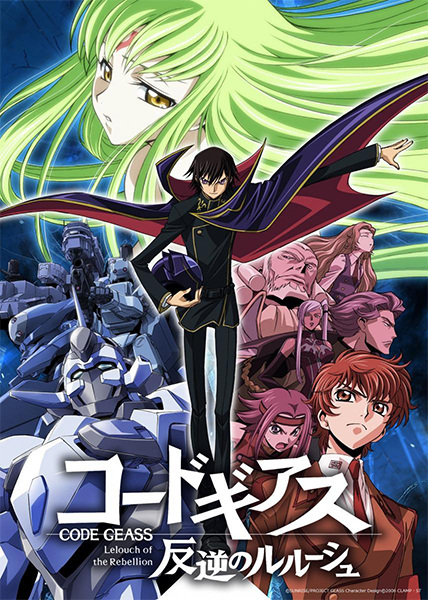
Code Geass
Is Code Geass worth watching?
Yes, it's worth watching. Anime Codex rates Code Geass 8.10 out of 10 — scored on six criteria (story, characters, themes, world-building, animation, and cultural impact), not crowd votes. 48th of 226 on the Codex rubric — top 21% of the catalogue. The crowd rates it 0.61 higher than the rubric does — the Codex is harder on it than on 54% of the catalogue.
Where to watch
What the data says
Computed from the Codex rubric across the whole catalogue.
Summary
Code Geass stands as one of the most influential mecha-drama titles of its era, blending political intrigue, mecha spectacle, and morally gray antihero storytelling into a propulsive package. Its greatest strength is Lelouch himself — a charismatic, self-destructive strategist whose crusade against Britannia doubles as a study in how liberators curdle into tyrants — sharpened by his ideological duel with Suzaku. Goro Taniguchi's direction and the distinctive CLAMP designs give it a bold visual identity, and the R1 pacing is relentlessly compelling, culminating in the devastating Euphemia sequence. Its weaknesses are real: the plot relies heavily on coincidence and convenient contrivance, Geass's supposedly fixed rules bend to narrative need, and the supporting cast beyond the central trio often feels underwritten and instrumental. The operatic, melodramatic tone can also flatten its otherwise pointed themes of colonialism and power. Yet within seinen mecha, few shows match its combination of intellectual ambition, entertainment value, and cultural reach. It is not flawless enough to be definitive of the medium, but it remains a high-water mark for the strategic antihero drama and a genuine gateway series that shaped a generation's taste.
Criterion breakdown
Story & narrative
The first season is a masterclass in escalating political chess, with Zero's terrorist-revolutionary campaign against Britannia driving genuine tension — the Narita mountain landslide gambit and the reveal of Suzaku piloting the Lancelot as Lelouch's ideological foil are standout structural beats. The plot leans hard on convenient coincidences (the sheer frequency with which Lelouch and Suzaku's paths intersect strains credulity) and Geass 'rules' that expand as the narrative demands. Even so, the momentum, cliffhangers, and the gut-punch of Euphemia's massacre in R1 make it one of the more compelling plotted mecha dramas of its era.
Character writing & growth
Lelouch is the engine — a theatrical, morally compromised antihero whose devotion to his sister Nunnally masks escalating hypocrisy, and his rivalry with the rigidly principled Suzaku gives the show its dialectical spine. C.C. and Kallen are strong presences, though the wider Black Knights and Ashford student cast often function as plot furniture rather than fully realized people. Some characters (Shirley, Mao) exist mainly to be leveraged emotionally, but Lelouch and Suzaku alone carry enough psychological weight to justify the score.
Themes & emotional resonance
The show interrogates ends-versus-means, colonial oppression, and the corrupting weight of power through Geass as literal coercion — Lelouch's 'absolute obedience' is a pointed metaphor for how liberators become tyrants. The Euphemia incident is the thematic climax, dramatizing how good intentions collapse under absolute power. However, the melodramatic register and operatic pacing sometimes undercut nuance, favoring spectacle and shock over sustained philosophical rigor.
World-building & power system
The alternate-history Britannian empire, the Area 11 colonial framework, and Knightmare Frame mecha combat form a cohesive and distinctive setting with real geopolitical texture. Geass itself is a genuinely original power premise, but its internal consistency is shaky — the specific limitation (one command per person, only working via eye contact) is introduced and then bent for dramatic convenience. The world's political logic is stronger than its supernatural rules.
Animation & direction
Goro Taniguchi's direction is kinetic and confident, and the CLAMP character designs give the show an unmistakable elongated silhouette. Knightmare battles are fluidly animated with strong choreography, and directorial flourishes — the dutch angles, the theatrical framing of Zero's speeches, the color-drenched dramatic reveals — elevate the melodrama. The visual identity is one of Sunrise's most iconic.
Cultural impact
Code Geass became a defining title of the late-2000s and a gateway anime for a generation, with Lelouch entering the pantheon of iconic antiheroes and Geass a widely referenced power concept. Its enduring popularity, memes, and continued franchise expansion (movies, R2, spinoffs) cement its lasting footprint in the medium.
Synopsis (from MAL)
In the year 2010, the Holy Empire of Britannia is establishing itself as a dominant military nation, starting with the conquest of Japan. Renamed to Area 11 after its swift defeat, Japan has seen significant resistance against these tyrants in an attempt to regain independence. Lelouch Lamperouge, a Britannian student, unfortunately finds himself caught in a crossfire between the Britannian and the Area 11 rebel armed forces. He is able to escape, however, thanks to the timely appearance of a mysterious girl named C.C., who bestows upon him Geass, the "Power of Kings." Realizing the vast potential of his newfound "power of absolute obedience," Lelouch embarks upon a perilous journey as the masked vigilante known as Zero, leading a merciless onslaught against Britannia in order to get revenge once and for all. [Written by MAL Rewrite]
Ranked nearby


Explore rankings
Discussion
Set a display name above to post.
Loading discussion…