The Naruto Watch Order, in Release Sequence: What Actually Matters and What You Can Skip
Franchise watch-order confusion is real; this lays out the Naruto entries in release order with what actually matters — the two TV spines, one non-canonical movie worth your time, and roughly nineteen hours of promotional filler you can safely ignore.
Franchise watch-order confusion is real; this lays out the Naruto entries in release order with what actually matters — the two TV spines, one non-canonical movie worth your time, and roughly nineteen hours of promotional filler you can safely ignore.
Twenty-four entries. Two of them are essential. That is the shape of the Naruto franchise once you stop treating every theatrical release as a mandatory checkpoint and start treating the watch order as a filtration problem.
The Consensus Is Wrong About the Movies
Popular franchise guides treat the eleven Naruto and Shippuden films as an optional-but-recommended appendix, ranked by animation quality or villain memorability. That framing is the mistake. None of the Studio Pierrot theatrical entries — from Ninja Clash in the Land of Snow in 2004 through Blood Prison in 2011 — are canon. Kishimoto did not write them. They exist in narrative parentheses, dropped into the TV timeline during arcs where the main cast conveniently has a week off. MyAnimeList scores them in the low-to-mid sevens with a consistency that should tell you something: the crowd cannot distinguish them from each other because there is nothing to distinguish.
Anime Codex scores Naruto at 7.28, against a MyAnimeList 8.29. That 500-episode Shippuden entry — Studio Pierrot, shonen, 2007 — is what carries the franchise. Story 6.8, character 7.5, themes 7.8, world 7.2, animation 6.5, cultural 9.5. The cultural score is doing structural work; the animation score is why the movies don't matter. If the flagship television production averages a 6.5 on visual execution, a theatrical spin-off produced on a compressed schedule is not going to redeem it.
The Naruto Watch Order That Respects Your Time
Here is the release sequence, annotated by what the rubric actually rewards.
Naruto (TV, 220 eps), 2002 — Essential. The 2002 series is where the character work begins and where Pierrot's animation ceiling gets set. The Chunin Exams arc and the Sasuke Retrieval arc are the load-bearing material; the roughly 85 episodes of post-Sasuke filler from the Land of Tea onward are the price of admission. Skip the filler if you want, though the Land of the Sea and Kurosuki Family arcs are less punishing than the reputation suggests.
Naruto: The Lost Story - Mission: Protect the Waterfall Village (SPECIAL), 2003 — Skippable. A 40-minute OVA screened at Jump Festa. Shibuki, one-shot antagonist, hero water. Nothing recurs.
NARUTO: Akaki Yotsuba no Clover wo Sagase (SPECIAL), 2003 — Skippable. The Mabui arc. Promotional. Non-canonical.
Naruto the Movie: Ninja Clash in the Land of Snow (MOVIE), 2004 — Skippable. The first theatrical release. Doto Kazahana, chakra armor, snow country. Watchable, inert.
Hidden Leaf Village Grand Sports Festival (SPECIAL), 2004 — Skippable. A five-minute chibi short. Included here only because release-order pedantry demands it.
Naruto the Movie: Legend of the Stone of Gelel (MOVIE), 2005 — Skippable. The second theatrical. Temujin, ancient civilization, no consequence.
NARUTO: Narutimate Hero 3 (OVA), 2005 — Skippable. A game-bundled OVA. Genin-vs-Jonin tournament framing. Fanservice.
Naruto the Movie: Guardians of the Crescent Moon Kingdom (MOVIE), 2006 — Skippable. Final Part 1 film. Spoiled prince, escort mission.
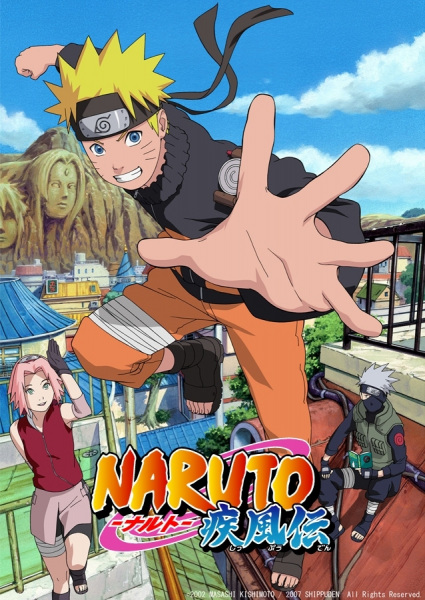
Naruto: Shippuden (TV, 500 eps), 2007 — Essential. This is the entry the Codex scores at 7.28, and it is the reason the franchise sits in the shonen upper-mid tier rather than the canon shelf. The Pain Invasion arc and the Fourth Great Ninja War contain the strongest material Pierrot ever animated for this property — Episode 167's Pain-Naruto confrontation, the Itachi-Sasuke fight in Episode 138, Kakashi's Kamui deployments in the war arc. The filler problem is worse here than in Part 1. Roughly 40 percent of Shippuden's runtime is non-canonical padding, and the Adventures at Sea filler in the mid-200s is genuinely difficult to defend. The story score of 6.8 reflects that pacing; the cultural score of 9.5 reflects the fact that none of it stopped the show from becoming, alongside Bleach and One Piece, the defining shonen export of its decade. For a broader map of where this lands against its cohort, the anime-like-Bleach cohort analysis traces the same footprint from an adjacent angle.
Naruto Shippuden the Movie (MOVIE), 2007 — Skippable. Priestess Shion. Prophecy plot. No canon.
Naruto Shippuden the Movie: Bonds (MOVIE), 2008 — Skippable. Sky ninja invasion. Notable only for a rare Naruto-Sasuke scene mid-Shippuden. Not canon.
Naruto Shippuden the Movie: The Will of Fire (MOVIE), 2009 — Skippable. Kakashi-focused. Watchable if you want another 90 minutes of Kakashi; the TV series does the character better.
NARUTO: THE CROSS ROADS (SPECIAL), 2009 — Skippable. Promotional short.
Naruto Shippuden the Movie: The Lost Tower (MOVIE), 2010 — Skippable. Time-travel premise, young Minato appearance. This is the closest a Shippuden film comes to canon-adjacent material, and it still doesn't matter.
Naruto, the Genie, and the Three Wishes, Believe It! (SPECIAL), 2010 — Skippable. OVA short. Comedic.
Naruto Shippuden the Movie: Blood Prison (MOVIE), 2011 — Skippable. Prison-break structure. The most competently constructed of the non-canonical films, which is not a high bar.
NARUTO: Honoo no Chuunin Shiken (MOVIE), 2011 — Skippable. Naruto-vs-Konohamaru comedic short.
Road to Ninja: Naruto the Movie (MOVIE), 2012 — Worth Considering. The one non-canonical film with a defensible case. Kishimoto wrote the screenplay. The Genjutsu World premise — Naruto meets alive parents, Sasuke is a flirt — surfaces character material the main series never touches, particularly Kushina and Minato. Not essential. But if you watch any of the eleven, watch this.
The Last: Naruto the Movie (MOVIE), 2014 — Essential. Canon. This is the Naruto-Hinata resolution the TV series ends without. If you finish Shippuden Episode 500 and stop, you are missing the closing bracket on the romance and the two-year time-skip bridge into Boruto.
Boruto: Naruto the Movie (MOVIE), 2015 — Essential. Canon. Introduces Momoshiki and Kinshiki, establishes the generational handoff, and covers material the Boruto TV series later re-animates less effectively.
Boruto: Naruto the Movie - The Day Naruto Became Hokage (SPECIAL), 2016 — Skippable. A companion short. Nice, inessential.
Boruto: Jump Festa 2016 Special (SPECIAL), 2016 — Skippable. Promotional.
Boruto: Naruto Next Generations (TV, 293 eps), 2017 — Conditional. The Momoshiki arc through the Kara arc contains material worth watching; the first 50 episodes of school filler do not. Whether Boruto is worth the runtime depends on your tolerance for a series that took years to justify its own existence — the same problem the Yu Yu Hakusho scorecard identifies from the opposite direction, where the finale is what's missing rather than the middle.
BORUTO: NARUTO NEXT GENERATIONS Part 2 (TV) — Pending. The Two Blue Vortex adaptation. Unscored.
The Case for Watching Everything
The strongest argument against this filtration: the Naruto franchise is a cultural artifact, and cultural artifacts are experienced completely or not at all. The 9.5 cultural score on the Codex scorecard is not a rounding error — it is one of the highest cultural marks in the catalogue, and it exists because a generation of viewers watched Ninja Clash in the Land of Snow on DVD and remembers it. The completionist reading says: the movies are the texture of what Naruto was as a phenomenon.
The rubric disagrees. Cultural impact scores the franchise's footprint, not the completeness of your viewing. Ten hours of non-canonical theatrical filler does not raise your understanding of the 7.28; it raises your runtime.
Verdict
Watch the two TV series and The Last and Boruto: Naruto the Movie. Watch Road to Ninja if you have curiosity to spend. Skip the other nineteen entries without guilt. The 7.28 was earned by two shows and a canon film that finishes what Episode 500 leaves open — everything else is promotional inventory.
Featured in the Codex
More from The Codex
The Seven Deadly Sins Is a 6.60 Wearing a 7.60 Costume: A One-Point Gap Earned by Groping Gags and Convenient Flashbacks
The Seven Deadly Sins scores 6.60 on the Codex against MyAnimeList's 7.60 because the crowd is grading a Netflix breakout and a Ban-and-King friendship, not the 24 episodes A-1 Pictures actually broadcast in 2014.
The 10.0 That Built a Sunday: How Sazae-san's Cultural Score Carries a 6.58 Scorecard
Sazae-san is a case study in how a single criterion — cultural — can define how a show is remembered, and the 10.0 the Codex hands Eiken's 1969 institution is doing every bit of the heavy lifting its other five scores refuse to.
The Sebastian Problem: Why Black Butler Sits 1.10 Below Its MAL Line and the Crowd Refuses to Notice
Black Butler (Kuroshitsuji) posts a 1.10-point gap between MyAnimeList's 7.65 and the Codex 6.55 because the crowd is grading Sebastian's silhouette and a Phantomhive aesthetic, not the anime-original finale A-1 Pictures actually shipped in 2009.
Discussion
Set a display name above to post.
Loading discussion…